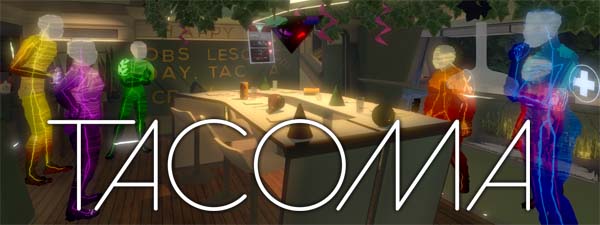
Here's another short sci-fi game from my Steam backlog. Tacoma is Fullbright's sci-fi follow up to its masterful walking sim Gone Home. This time around, instead of playing as a young girl discovering the secrets of your family, you play as an agent of a corporate conglomerate sent to retrieve the company's A.I. hard drive from a defunct space station in which an emergency threatened to kill the entire crew. Instead of reading notes and journal entries, you instead replay holographic representations of logs that the station's onboard A.I. recorded of conversations between the station's crew members.
You have to eavesdrop on recorded conversations as holograms move around the station.
The whole process is much more active and player-driven than the exposition of Gone Home (and other walking sims) because the holographic recordings of the characters move around the stations and converse in real time. You don't just walk into a room and read a conspicuously-placed note or listen to passive narration. You'll have to follow the characters between rooms, and keep track of multiple conversations at once as the characters come and go, and as they split up from large group meetings and start to have smaller, more private conversations. Each recording will usually have 2 or 3 independent conversation threads for you to follow. As you follow each character around, you'll also be spying on their personal text messages and emails.
This gives a greater sense of participation from the player (compared to many other walking sims) and provides a greater illusion that you are solving a mystery. That being said, there's nothing too challenging about finding and listening to all the possible conversations. They aren't elaborate puzzles that will take time to figure out. You just follow each character around the space and listen to them. It keeps the player interacting with the game space without ever applying a high bar for progress.
Don't expect to be stumped by the puzzles.
Without spoiling too much, there is only one ending, and you aren't going to be punished for not uncovering all the available evidence. The worst aspect of the game's "walkign sim" nature is that you're also never asked to apply any of the knowledge that you acquire from your investigations other than a handful of numeric combination codes for unlocking doors and the like. These codes are basically just progress gates to provide the illusion that the game has "puzzles", but the early exposure to these key codes will further encourage the player to snoop around more thoroughly for potential clues to future puzzles or progress gates. It isn't very intellectually challenging, but it does encourage the player to pay more attention.
[More]
ad0da423-9efe-41a3-b0fc-37ab8db4fe16|0|.0
Tags:Tacoma, Fullbright, science fiction, walking simulator, artificial intelligence, corporate culture, stock market, Amazon, Tyson Foods, COVID-19, pandemic
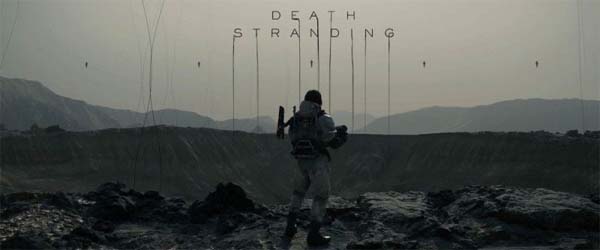
I had no clue what to expect from Death Stranding. I probably would have bought it regardless because I usually enjoy Kojima's games. I was also curious if Death Stranding would be, in some way, representative of what the canceled Silent Hills might have been. Most of all, Kojima is a bold, and usually innovative creator, and I felt compelled to support his new studio -- if for nothing else than to give a middle finger to Konami.
After spending several dozen hours with it, I'm still not really sure what to think of Death Stranding. Much like with Final Fantasy XV, Death Stranding is loaded with novel ideas and messages that I find personally interesting or compelling. But just like Final Fantasy XV, those novel ideas take a back seat to time-wasting filler quests. Death Stranding can be hypnotically beautiful, zen-like, and maybe even emotionally moving, but it's also big, bloated, and convoluted, and it takes far too long to get where it's going.
At a very reductionist level, Death Stranding could be accurately characterized as "side quest: the game" or "Amazon courier: the game". But that characterization would be overlooking the nuance behind the game, and what it has to say about modern gaming and society in general. That makes it a very difficult game to review without giving one's self some time to let it soak in ... which is part of the reason why I've been mulling it over for more than a month now...
Rebuilding America, one Amazon delivery at a time
Carrying cargo is, in fact, the entire game! Our protagonist, Sam, is unwittingly tasked with delivering cargo across this post-apocalyptic America in an attempt to get in the good graces of the settlements dotting the land, and connect them all up to a vast information network to restore a semblance of civilization. On the way, you can literally build roads and bridges as you go -- rebuilding the American infrastructure little by little.
Online players will leave guideposts and infrastructure to help each other out.
This infrastructure is actually a clever implementation of the Demon's Souls / Dark Souls style of asynchronous multiplayer. In principle.
Instead of the ghostly visages of other player warning you of traps or ambushes or pitfalls, online players can build bridges, roads, vehicle charging stations, storage boxes, and other helpful infrastructure that will make your trek through the world legitimately easier. They aren't just cluing you in about what dangers to expect, or what course of action to take, the other players are actively helping you (and everyone else) without ever needing to set a digital foot in your game. Just like in FromSoft's Souls games, you can also leave little notes that take the form of emoticons, and which combine the function of the Souls player messages with avatar gestures.
When you first step out into the world, there's a sense of desolation and loneliness about the landscape. It reminds me a lot of Shadow of the Colossus, except our only company is a crying fetus instead of Aggro (who's such a good horsey!). The scenery itself is more evocative of Iceland, and doesn't look like any part of the United States that I've ever been. But then again, this is the same game designer who put a tropical rainforest in the middle of Soviet Russia, so... It's beautiful and serene, and figuring out how you're going to navigate the environment can be a legitimate zen-like puzzle.
Trekking through the map reminded me of the beautifully desolate environments of Shadow of the Colossus.
This game requires very precise and deliberate inputs from the player, and it can sometimes be very unforgiving of small mistakes. If you turn too quickly, Sam may lose his balance and fall over, possibly damaging or destroying the packages that you are carrying. Walk to quickly down a steep slope, and you'll risk loosing your footing and face-planting. You can hold one or both trigger buttons to try to stabilize yourself or catch your balance -- and there's no real reason to not hold both triggers the entire game, since balancing your load doesn't make Sam walk noticeably slower. And you'll have to manage Sam's stamina, the battery supply of vehicles or certain tools, and so forth. You might even find your hands cramping from holding down the triggers after a particularly long or strenuous journey over rough terrain, providing you with a small degree of physical discomfort to go along with Sam's physical exhaustion. And you'll be pushed along by occasional rainfall that will cumulatively damage your cargo and equipment.
Even though Sam will progressively get stronger and better able to keep himself balanced, and even though the game will gradually unlock new mechanics for making it easier to traverse the landscape, you can never get sloppy, and the game will punish you for impatience! It reminds me a lot of Dark Souls, except instead of getting killed by a hollow undead sword flurry because I thought I could sprint through a return trip through an early area of the game, I'm instead tripping over my own two feet because I tried to run down a mossy slope to get this delivery done faster.
Simply navigating the open world terrain without tripping and falling is a primary gameplay mechanic.
The terrain is important and relevant, and navigating it safely and efficiently is the game's core gameplay. You aren't simply holding the stick forward and walking a straight line to a point on the mini-map or radar, as you might do in, say, Skyrim or Far Cry. This is how you design an open world game! You make the traversal of the space into the operant challenge. Or, at the very least, make the space between landmarks -- and the act of traversing that space -- feel meaningful. I feel like game designers are really starting to vindicate all those blogs that I wrote years ago about the failings of open world design. The destinations aren't important in Death Stranding. It's the space in between (the open world itself) that is important.
... [More]
b05094b6-4edc-4826-a70a-dd41aa427e42|3|5.0
Tags:Death Stranding, Hideo Kojima, Kojima Productions, Norman Reedus, Guillermo del Toro, Mads Mikkelsen, Lea Seydoux, Tommie Earl Jenkins, post-apocalypse, open world, Amazon, Twitter, porter, hiking, backpacking, camping, infrastructure, asynchronous multiplayer, cooperation

In their single-midned insistence on making all of their movies about epic showdowns between the superheroes and some big bad guy, the DC movies have consistently failed at depicting their heroes as having any particular desire or inclination to actually help people. This is perhaps the greatest failing of the Zack Snyder / Henry Cavill Superman movies and the greatest strength of the classic Richard Donner / Christopher Reeve Superman films: Snyder's / Cavill's Superman seems to treat saving people as a begrudging chore that he's obligated to do; whereas the classic Donner / Reeve Superman put on a charming smile and went out there to do good for the sake of doing good, simply because he is capable of doing good.
Well now, DC seems to have finally realized that the primary role of its superheroes is to be idealistic saviors and protectors. For the first time in the DCEU movies, our hero shows the idealistic optimism and desire to help people and do good that has been the trademark of the classic Superman films and the Spider-Man films (heck, even Amazing Spider-Man 2 got that right). But in this case, our hero isn't Superman or Spider-Man; our hero is Wonder Woman.
I actually don't mind the darker aesthetic and tone that DC has adopted for its movies. The problem so far has been that those movies have been dark and poorly-written and thought-out. Wonder Woman, on the other hand, is a much brighter movie (both in terms of visuals and thematic tone), and benefits from much tighter writing. The script is solid and tightly-themed, Wonder Woman has a full and nuanced character arc, the performances are good, the action looks slick, and (most importantly) it's easy to follow along with what's happening.
The biggest failing of the Zack Snyder / Henry Cavill Superman is that he seems to be begrudgingly helping people,
instead of happily doing good for the sake of doing good (as in the Richard Donner / Christopher Reeves Superman).
Gal Gadot provides a great performance that proves that her stealing the show in Batman v Superman wasn't just a fluke or a simple sign of how bad the rest of that movie was. She actually works well in this role and is almost as charming a Wonder Woman as Christopher Reeve was at being Superman. The supporting cast mostly works, and this is probably the best role that I've seen for Chris Pine to date. Some of the secondary characters are a bit under-written and lack screen time, but everyone (no matter how minimal their screen-time) has a role to play that helps shape Diana as a character. There's no superfluous characters like Louis Lane in either of Snyder's Superman movies. The only exception being, maybe, Steve Trevor's secretary, who actually deserved a lot more screen-time that she received.
Even Doctor Poison seemed to have a little bit of complexity and nuance to her character. She does suffer from some poor, underwritten motivation, as the movie never really seemed to go too deep into why she's doing what she's doing. But it's definitely apparent that there's something going on under the surface, beyond simply being manipulated by higher forces. The closest that I could figure is that she has some kind of relationship with General Ludendorff and is blindly loyal to him, but she at least wasn't a bad guy for the sake of being a bad guy.
Hits and misses
The only major weakness of Wonder Woman, as a movie, is that it's a bit of an uneven work. It's broken down into a readily discernible three-act structure. The first act is great, the second act is okay, and the third act sinks towards the DC stamp of terribleness. The unfortunate thing about this is that I walked out of the theater with a bad taste in my mouth, even though the movie was still mostly pretty good. So far, DC's movies have all started out mediocre and progressed towards terrible by the end. Wonder Woman, however, starts out good and starts to sink in the direction of bad at the very end. Which, I guess is a big improvement.
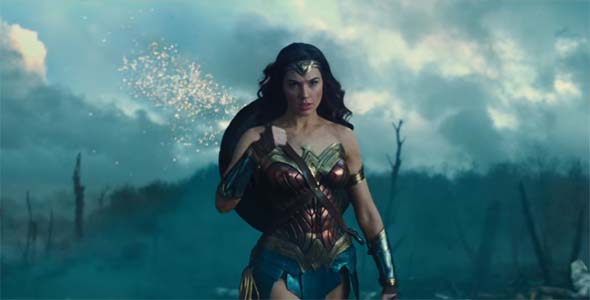
Act II concludes with Wonder Woman getting her first real "hero shot" in the movie.
The first act, set on the island of the Amazons, is colorful and vibrant. It's beautifully shot, with interesting and well-choreographed action sequences, and sprinkles of humor. If you didn't know better, you might be justified in mistaking it for a Marvel movie... [More]
40842c3b-0456-4b21-81c3-4fd9a6e449a8|0|.0
Tags:Wonder Woman, DC Comics, Gal Gadot, Diana Prince, Doctor Poison, Steve Trevor, Zeus, Ares, God of War, Amazon, Chris Pine, World War I, Germany, trench warfare, chemical weapon, mythology, Patty Jenkins, Zack Snyder
I haven't had a good rant on this blog for a long while. At least, not one that isn't part of tearing apart a terrible game in a review. But I have something that's been really grinding my gears throughout all of 2016, and I need to say something about it: I really dislike advertising. I have an especially intense dislike of internet advertising practices. It's not the ads themselves that get on my nerves; it's the ways in which websites and advertisers chose to deliver them. So many websites are crammed full of ugly, intrusive, and obnoxious ads that really hurt the experience of the user trying to actually view and navigate the website.
Streaming services like Comedy Central insist on crashing the video in the event that there's even the remotest hiccup in loading one of the five advertisements that it must play during the four advertising breaks that it includes in its half-hour episodes. I routinely run into issues in which the pre-episode ads fail to load, and so the whole episode refuses to load, and I have to ctrl-F5 to reload the page until it selects a set of five advertisements that actually work. But then it gets to one of the mid-episode commercial breaks, and even if the advertisements do load and play, the actual episode refuses to continue. Sometimes, I can hit the "rewind 10 seconds" button to fix the problem. Other times, I once again have to ctrl-F5 to reload the page, sit through the pre-episode ads again (hoping they don't cause yet another failure), then skip past the ad break in the timeline, watch the mid-episode ads (and hope that they don't also fail), and then maybe I can continue watching the content. This is why I haven't seen an episode of The Daily Show in a couple months and have no idea if new host Trevor Noah has finally hit a stride yet. I have similar issues with CBS steaming, which is why I also haven't been able to watch much of Stephen Colbert's new late night talk show. Sorry Stephen, I love you, but CBS apparently doesn't want me to watch you.
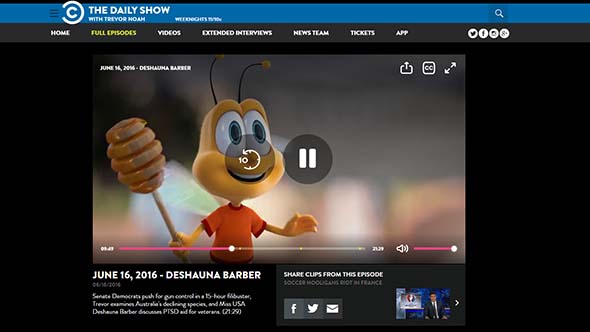
Issues with Comedy Central's ad-delivery abound: ads play over the actual content, their failure to load
prevents the content from playing, they have multiple ad breaks and not enough unique ads to fill them, etc.
To make matters worse, Comedy Central and CBS often doesn't even have enough distinct ads to fill up all these advertising breaks. I often see the same three or four ads in every ad break. Sometimes, the same exact ad will play back-to-back during the same advertising break!
Is this supposed to be punishment for not watching the show on cable TV? I actually do (at the time of this writing) have an active cable subscription, and that subscription does include Comedy Central and CBS. I could easily just DVR episodes of The Daily Show or Late Show with Stephen Colbert and watch them at home, but I prefer to watch them during my sit-in lunch breaks at work because it's just a more efficient use of time. Or at least, it would be, if it ever actually worked. Heck, on the DVR, I can just skip past the damned ads. I can't do that when streaming on the internet.
Comedy Central is far from unique in this regard. I've already pointed a finger at CBS as well, and this is one of the reasons that I'm not happy about Star Trek: Discovery being exclusive to CBS All-Access. I really don't want to pay for a streaming service to watch one show! Especially if it's still going to contain content-breaking advertisements that prevent me from even watching the show that I'm paying to watch... [More]
94497a0d-abb4-4a08-bedb-b4a985a495ef|2|5.0
Tags:advertising, advertisement, internet, streaming, video, content providers, internet service providers, cable, television, AdBlock Plus, The Daily Show, Trevor Noah, Stephen Colbert, the Late Show, CBS, all access, NFL, ESPN, Chicago Bears, football, Zero Punctuation, Disney, Disneyland, Amazon, Amazon Associates, Patreon, Kickstarter, crowd-funding, government, regulation
|

| 12 | | | | | | | 60 | | 11 | | | | | | | 55 | | 10 | | | | | | | 50 | | 09 | | | | | | | 45 | | 08 | | | | | | | 40 | | 07 | | | | | | | 35 | | 06 | | | | | | | 30 | | 05 | | | | | | | 25 | | 04 | | | | | | | 20 | | 03 | | | | | | | 15 | | 02 | | | | | | | 10 | | 01 | | | | | | | 05 |
|