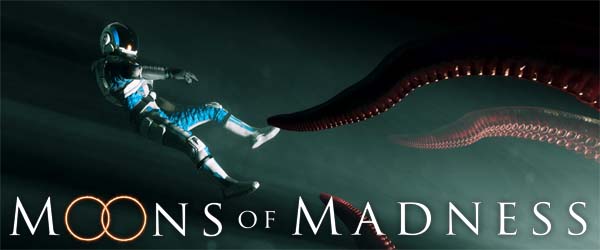
It's hard to make a good Lovecraftian horror game. The key to Lovecraft's horror was the mysterious intractability of his cosmic abominations. It wasn't just that they were ugly or deadly; the horror came from the realization that these monsters were part of a much greater cosmos that humans can barely comprehend, and that we are little more than ants to these god-like beings who could snuff us out of existence at a whim -- if they even cared enough about us to do so. In the century since Lovecraft wrote his stories, Lovecraft's monsters have become so iconic that Cthulhu is pretty much a universally-recognized, cliche monster along with the likes of Dracula and the Xenomorph. The closer a story adheres to Lovecraft's ideas, the more familiar it becomes, and the harder it is to create that sense of being overwhelmed with unfathomable knowledge that drives a person insane.
That is why I think that FromSoftware's Bloodborne is perhaps the best video game adaptation of Lovecraft's concepts (even though it is not a direct adaptation of any of his stories). Bloodborne's esoteric and arcane lore, and the indirect nature in which it communicates its backstory, actually does create that sense that the player is just a small piece of a much larger puzzle that you will never fully comprehend. And the difficult nature of the game means that the player certainly feels like you can be snuffed out of existence at any moment.
Moons of Madness isn't mysterious, or arcane, or particularly threatening. It's cliche and predictable to a fault.
Flatline
I saw almost every plot point coming from a mile away, and if you don't want spoilers, then I suggest you skip ahead to the next section. I didn't expect there to be a full-on underground lab complex akin to Resident Evil 2, but it wasn't something that came off as very surprising considering how telegraphed the corporate conspiracy "twist" was from the start. All the other twists, however, came off as rote and stale. The science experiment gone haywire, the relief ship crashing, the reveals about the protagonist's family history, the multiple betrayals ... none of it came off as even remotely surprising, and the whole game degraded to simply waiting for the next shoe to drop. The game isn't very long, but the predictable nature of its plot made it feel like it was dragging on for much longer than its six-ish hour playtime.
The secret lab was not a surprise and only distracted from the cosmic horror.
Worse yet, the corporate conspiracy stuff ended up distracting from, and drowning out, the Lovecraftian cosmic horror. The monsters don't feel mysterious because they're all the results of experiments being done at the request of the evil corporation. The Lovecraftian temple complex and "dreamers" fall flat because their existence is spoiled much earlier in the game. Heck, the other characters visit the temple and tell you all about it over the radio, while you're fumbling about the silly underground lab, so by the time you get to the temple, it's not mysterious at all. I think the point was to try to convey the awe and wonder of the NPC characters in the hopes that it would instill a sense of awe and wonder within the player, but all I could think was "I'd much rather be playing as those other characters right now!"
When all is said and done, I feel like Observation (despite not being directly inspired by Lovecraft's mythos) pulls off the cosmic horror shtick much better because its alien influences remain mysterious and intractable all the way through the end -- perhaps to that game's fault.
... [More]
942aeb04-c29d-447b-8525-5e4dcfd19326|0|.0
Tags:Moons of Madness, Steam, Rock Pocket Games, Dreamloop Games, Funcom, science fiction, horror, cosmic horror, H.P. Lovecraft, walking simulator, Mars, conspiracy
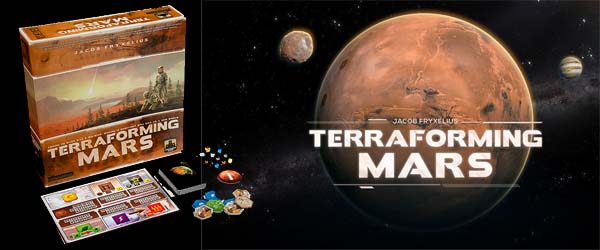
Steam recently released a digital version of the board game Terraforming Mars. I haven't played the digital version (which is getting "mixed" and negative reviews at the time of this writing), but I have played the board game version. It's pretty fun, and in celebration of the latest NASA probe landing on the surface of Mars, I thought I'd launch a review of the board game.
Terraforming Mars has a wide variety of gameplay mechanics, which makes it kind of difficult to clearly categorize it. It also makes it a little difficult to teach the game to new players efficiently. It's not an overly-complicated game, however. It's just a lot of different concepts that you have to explain. Regardless, I've been able to get through learning games with new players in about three or three-and-a-half hours (including the rules explanation). So it's not overly burdensome to learn and play. It's also not terribly hard to simply play a sample round to teach the game flow, and then mulligan the game if any players feel they dug themselves into a hole.
Terraforming Mars has multiple distinct mechanics, ranging from tableau-building to tile-placement.
There's tile placement with adjacency bonuses. There's resource management. There's action economy. There's a little bit of tableau building and hand management. There's even a certain degree of bluffing. Playing with the non-basic corporations adds variable player powers, You can even optionally play with card drafting! Pretty much the only thing that we're not doing is loyalty / betrayal mechanics. Despite including so many varying game mechanics, nothing feels out of place, and everything fits together well.
The rulebook includes footnotes explaining the scientific basis for the rules and mechanics.
Depending on how you play, however, the actual game board and your tableau of cards can sometimes feel very disparate. If you're not actively placing tiles on the board, then the whole board can pretty much boil down to a score and prerequisite tracker. However, if you're avoiding placing tiles on the board, then you're probably going to lose, as I've yet to see a predominantly card-based strategy win the game.
The board itself includes a map of Mars' surface, and has notable landmarks on Mars clearly labeled. Unfortunately, the board only covers one half of Mars' surface, so there's some notable landmarks that are not included at all (perhaps the other side of the planet is an expansion?). The resource cubes are very shiny and pretty, and have an appropriately sci-fi aesthetic to them. The rulebook also includes little footnotes that explain some of the scientific bases for the game's rules and mechanics. it's like the kind of thing you might expect if Neil DeGrasse Tyson wrote a board game. Science and space nerds will probably really appreciate these efforts at scientific accuracy.
The resource cubes are pretty, but shift around very easily on the flimsy, card stock economy boards.
Other components besides the resource cubes are kind of cheap and flimsy though. The player economy boards are printed out on basic card stock. There aren't any slots or grooves for the production cubes to sit in, so they slide around very easily if the table is jostled, or if the economy board is shifted around. You may want to invest in some third-party replacements or overlays in order to solve this problem.
The box also doesn't have any inserts of any kind for storing components -- just a handful of plastic, zip-lock bags. They expect you to just drop all the cards in a plastic baggie and just toss them in the box haphazardly along with all the other pieces!
At a price point of $70 (USD), I expect more from a game's components! Fortunately, where the game lacks in production value, it more than makes up for in entertainment value!
... [More]
ef527080-aedf-4583-a72d-8d6ee9108d4f|0|.0
Tags:Terraforming Mars, Stronghold Games, Jacob Fryxelius, board game, Mars, space, science fiction, terraforming, technology, hex, tile, city, forest, ocean, temperature, oxygen, victory points

I never played the original Doom. I didn't get into PC gaming until the mid twenty-aughts, and even then didn't play much in the way of first person shooters that weren't the first two Call of Duty games. I was always more into SimCity and Civilization. So I was in no rush to play 2016's reboot of Doom, nor can I really look at it from the perspective of how it holds up against the original's legacy. I heard a lot of good things about it, and picked it up on this year's Steam summer sale.
Bethesda recently announced a sequel, so I thought I'd check this one out to find out if I should be excited.
I miss the good ol' days of game demos being available before a game releases.
I actually did play the free demo on the PSN months ago, which was an option for me because the game's been out for two years already (does this count as a retro review?). I miss the days when free demos were available before a game's release, so we could try it before we buy it. Sigh. Anyway, I had a lot of trouble with hitting enemies with a PS4 controller considering how fast and movement-oriented the combat is, but I definitely saw the potential enjoyment that I could have with the finer control of a mouse. So I went ahead with the Steam purchase.
Punch a demon in the face
Doom breaks from the cover-based mold set by most recent big budget first-person shooters by encouraging very fast, very frenetic, very aggressive, and very in-your-face action in a fashion similar to Bloodborne. Staggering an enemy allows you to perform a melee "Glory Kill" that provides you with a shower of health pick-ups and ammo. When your health is critical, the best course of action usually isn't to run away and take cover (like in so many modern cover-based shooters); rather, the ideal strategy is often to find the biggest, meanest demon, shotgun it in the face, and then rip its head off with your own bare hands. This keeps the player in the action, and mostly removes the need to backtrack through a level to find health kits and powerups. It's not quite as tactical or thoughtful as the dismemberment system from Dead Space, and some might argue that it's derivative of the chainsaw from Gears of War, but it does help to create a definite flow to the combat that helps it to stand out from other shooters of the era.
Charging an enemy is often the best way to restore your health.
The default move speed is faster than the sprint of most other modern shooter games. You can press 'Shift' to toggle a "walk" mode, but I honestly don't know why you would ever want to, and I never once used it after experimenting with the controls at the start of the game. Most enemies also charge at you with melee attacks or have actual projectile attacks (as opposed to hit-scan weapons). You don't avoid damage by ducking behind cover; instead, you can usually just side-step an incoming projectile or attack. Again, because of the fast speed of the character, the term "side-step" isn't really apt; it's more like a "side-sprint".
This all creates a very retro feel that [I assume] faithfully captures the spirit and fluidity of the original game's combat. It's an experience more akin to a first-person bullet hell game rather than the cover-based, whack-a-mole shooting galleries that define most modern shooters. [More]
2028a05f-7ac8-4aa6-83e8-785b11e76705|0|.0
Tags:Doom, Id Software, shooter, first person shooter, Hell, demons, occult, Mars, science fiction, horror, action

I dropped the ball on this one. I often criticize Hollywood for not being willing to make genuine, hard science fiction movies anymore, and I begroan the continued bastardization of my beloved Star Trek and the dumbed down action flicks that Hollywood dared to put the "Star Trek" title on. The studios say that science fiction don't make enough money. Apologists say that casual audiences are too dumb and impatient to sit through any kind of slow-developing, cerebral movie. Ironically enough (despite my own frequent cynicism) I think both these apologetics are too cynical and don't give audiences enough credit. I firmly believe that if the studios make a good movie, the audiences will go see it, especially if it's properly marketed.
So when a thoughtful, science fiction movie like The Martian comes out, I try to make a point of spending my money to see it in order to show my support for the continued development of the genre. I made a point of seeing Gravity, despite that movie appearing to be little more than space destruction porn and iMax eye candy. I also made sure that I saw last year's Interstellar. And both of the Planet of the Apes reboots have been surprisingly excellent. Unfortunately, I lost track of the release date of The Martian and missed seeing it on opening weekend (one of Hollywood's biggest metrics of a movie's success). I also wasn't able to see it the week after, or the week after that due to my weekends being consistently busy. It was over a month before I finally put my foot down and said "I'm seeing this movie now! No more delay!". And then I went and saw it twice in that same weekend.
Fortunately, the rest of the country vindicated me by heaping dump trucks full of praise on the movie and putting their butts in the theater seats to keep The Martian at the number 1 spot in the box office for almost the entire month of October (only briefly falling to number 2 for one week behind Goosebumps - really?). It finally took an upteenth sequel to a beloved franchise to topple The Martian when Spectre (which I also saw this weekend) held the top spot for two weeks in a row. The movie itself is earning Oscar buzz, and Matt Damon seems to be the current favorite for "Best Actor". So there you have it, Hollywood: make a good sci-fi movie, and they will come, and they will love it.

Matt Damon's character is charming and easily has the audience rooting for him against all odds.
And the movie is absolutely fantastic! It's ambitions are closer to Apollo 13 than to 2001: A Space Odyssey. It's a very believable, down-to-earth, science fiction film, the events of which feel like they could happen tomorrow. Matt Damon's performance is absolutely charming as a NASA astronaut stranded on Mars and presumed dead when his team is forced to evac due to a violent sandstorm... [More]
07512981-d696-4a06-9ee6-d639a967a128|0|.0
Tags:The Martian, Matt Damon, Ridley Scott, science fiction, Mars, space, NASA, astronaut, Ares, Pathfinder, optimism, Oscar
This morning, the first step on the road to a manned mission to Mars was taken. NASA's Orion space capsule successfully completed its first dual-orbital test flight and splashed down in the Pacific Ocean.
The space craft finally launched this morning from Cape Canaveral Air Force base a little after 7 am Eastern time, after having been delayed for a day due to technical problems and poor weather. After a four-and-a-half-hour flight in which the spacecraft orbited the Earth twice at an altitude of 3600 miles, the capsule re-entered the atmosphere, deployed its parachutes, and landed gently in the Pacific Ocean.
This flight is the first step in a planned manned mission to Mars that is expected to take place within the next 25 years, assuming that it doesn't get derailed by political or monetary issues.
This is exactly the kind of mission that advocates argued would be encouraged by the termination of the space shuttle program. Critics argued that the space shuttle made access to earth's orbit too easy and reliable, and "tethered" NASA to low-earth orbit, instead of finding innovative new ways to reach further into space... [More]
ba8efa03-b9f9-484b-930e-b406ee908904|0|.0
Tags:Orion, NASA, National Aeronautics and Space Administration, science, Mars, orbit, space shuttle, Apollo, Cape Canaveral, SpaceX, China
|

| 12 | | | | | | | 60 | | 11 | | | | | | | 55 | | 10 | | | | | | | 50 | | 09 | | | | | | | 45 | | 08 | | | | | | | 40 | | 07 | | | | | | | 35 | | 06 | | | | | | | 30 | | 05 | | | | | | | 25 | | 04 | | | | | | | 20 | | 03 | | | | | | | 15 | | 02 | | | | | | | 10 | | 01 | | | | | | | 05 |
|