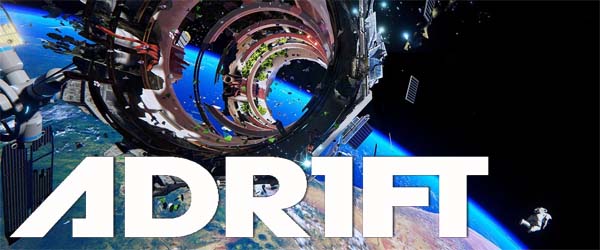
While I was searching the PlayStation Store for some VR games to play on my PSVR2 headset (and on a PS4 VR headset that a friend let me borrow, since the PSVR2 headset isn't backwards-compatible), I stumbled upon an old sci-fi game that had apparently slipped under my radar when it released back in 2016. That game is a near-future space disaster game called ADR1FT. Unfortunately, this particular game doesn't have PSVR support, even though it apparently does have PC VR support, but it looked pretty and intriguing, so I bought it anyway.
Space station by Michael Bay and Roland Emmerich
In ADR1FT, the player plays as an astronaut who is a survivor of a catastrophic disaster aboard an orbital space station. The entire station has broken apart, and even the sections that are still intact are without power or life support. It is up to the player to explore the debris, look for any other survivors, and restore enough power and computer functionality to escape back to Earth in an Emergency Escape Vehicle (EEV). Personally, I think it's silly that an Emergency Escape Vehicle would be rendered useless in the event of an emergency that disables power and computer functionality. Kind of defeats the purpose of such a vehicle. One would think that such a vehicle would have an independent power supply and computer, and some way of detaching or ejecting the vehicle without the station being powered -- like, I don't know, some kind of explosive decompression of the clamps that attach the escape vehicle to the station, which works based on simple physics, rather than requiring power or computers.
But whatever, suspension of disbelief. I have to restore power to the main computer to get the escape pods to work. Fine. I can live with that contrivance.
The space station debris hovering over the Earth is a striking visual.
The space catastrophe itself is loaded with striking visual details. From the vistas of the Earth spinning below, to the fields of debris suspended in space, to water bubbles floating around certain chambers, ADR1FT really sells the look and feel of being trapped on a near-future destroyed space station. This includes the feeling of isolation, loneliness, and hopelessness of being trapped in space. In fact, it might be too good at selling this aesthetic, because it does so to the point of occasional frustration. [More]
This will be the second part of a 2-part Retrospective on Civilization VI. The first part features my personal list of Top 10 Good Ideas that Firaxis put into the game, and this second part will be the Top 10 Bad Ideas. If you haven't read the Good Ideas yet, then I highly recommend you check that out first, as there will be several topics in this list that will build on what was said in the previous list. In fact, there will be some topics that are appearing in both lists, so I hope you'll read the good things that I have to say before reading the bad.
I also don't want to be a complete downer, and would like to provide constructive feedback. So wherever possible, I will try to make suggestions on how I think Firaxis could improve on some of these ideas if they chose to revisit them for future games. And some of these ideas are certainly worth re-visiting.
This content is also available in video essay format via YouTube.
[More]
07ea0b45-5d98-4ac1-9e2c-064bddd336aa|1|5.0
Tags:Civilization VI, Civilization VI: Rise and Fall, Civilization VI: Gathering Storm, Civilization VI: New Frontiers Pass, Sid Meier's Civilization, retrospective, top 10, privateer, pirate, world congress, agenda, leader, museum, trade route, wall, diplomacy, disaster, climate change
With the New Frontiers Pass for Civ VI over, an "Anthology" edition of Civ VI on sale, and no news at all regarding future DLC or expansions, I'm assuming that Firaxis has finished with Civ VI. As such, I want to look back on the game and reflect on the things that I liked most about it, and the things that annoyed me the most.
After the lifespan of Civilization V had ended, I wrote up a pair of retrospective blogs about my personal Top 10 Good Ideas and Top 10 Bad Ideas that went into that game. I'll be doing the same thing now with Civ VI.
I want to stress that this is a list of 10 good and bad ideas -- not necessarily good and bad mechanics. Some of the good ideas will be ideas that I like in principle (or on paper), but which might need more iteration before they truly work as intended. In contrast, there may be some bad ideas that work fine mechanically, but which hurt the "flavor" or theming of the game, in my opinion.
This is, of course, a subjective list of personal favorite and disliked concepts in the game. I'm sure there will be a lot of disagreement, and some of the things I write here will probably be somewhat controversial with the rest of the player base. So I'm interested in reading others' feedback. So if you agree with any of my points, or you vehemently disagree, feel free to post a comment and share your thoughts.
This content is also available in video essay format via YouTube.
This first post will cover my personal Top 10 Good Ideas, and I will follow it up with the next post being about the Top 10 Bad Ideas. [More]
549df3d2-8086-446d-bb11-35103ccef5b9|1|5.0
Tags:Civilization VI, Civilization VI: Rise and Fall, Civilization VI: Gathering Storm, Civilization VI: New Frontiers Pass, Sid Meier's Civilization, retrospective, top 10, music, Christopher Tin, Baba Yetu, agenda, wall, scout, skirmisher, ranger, diplomacy, alliance, disaster, climate change, barbarian, city state, leader
This past weekend, I put up my review of Gathering Storm, the new expansion for Civilization VI. The overall summary is that I felt very "meh" about the game's headline features, but was actually impressed by how the smaller, more subtle changes really improve the underlying game. That review focused on a lot of the high-level concepts of the game, and was already starting to get rather long (my readers all know how verbose I can be). I decided to cut a lot of my smaller criticisms of individual mechanics or functionality out of that review, and save them for their own separate post.
So now that you all know how I feel about the expansion overall, here's some of my smaller nags and nitpicks (and suggestions for resolving them) that I hope can be resolved by some post-release patches.
Table of contents
Civs who don't pollute should gain Diplomatic Favor
[More]
648e5396-2c29-4d24-8cbc-3a47e3e48539|1|5.0
Tags:Sid Meier's Civilization, Civilization VI, Civilization VI: Gathering Storm, weather, disaster, flood, world congress, diplomatic favor, strategic resource, oil, iron, coal, user interface
It's refreshing to see a video game (of all things) take seriously the second greatest existential threat to civilization (after nuclear weapon stockpiles), while governments (particularly here in the United States) fail to even acknowledge that it's real. I was honestly a little bit surprised to see anthropogenic climate change be the focus of an entire expansion to Firaxis' Sid Meier's Civilization VI. Firaxis has been playing very "politically correct" with the game in its past two iterations. Civ IV, if you remember, included slavery as a mechanic that allowed players to kill population in exchange for a production boost, and it included leaders like Joseph Stalin and Mao Zadong. Civilization III allowed collateral damage from city sieges that would kill population, destroy infrastructure, and potentially reduce wonders of the world to mere ruins. Civilization II allowed democratic congresses to overrule the choices of the player. And Civilization: Colonization actually required you to draft citizens from your cities into soldiers to fight wars.
Politically sensitive concepts like slavery, and characters like Joseph Stalin, have been in Civ games before,
but Civ V and VI have played things very safe and controversy-free with most of their content.
Civilization V and VI have dialed back from such concepts and leaders, as well as other "politically sensitive" topics in favor of diversity, inclusiveness, and a more rose-tinted vision of human history that tries to pretend that things like slavery, colonialism, opium wars, and the Holocaust didn't happen. I get it. They're going for a more optimistic vision of humanity that celebrates our achievements while overlooking the incalculable amount of [often unnecessary] suffering that came at the expense of many of those achievements.
So to see Anthropogenic Global Warming not only be included -- but to be the headline feature -- is surprising. I mean, I don't think it's a politically or culturally sensitive topic, nor should it be to anyone else if we lived in a rational world. It's the reality that we live in -- plain and simple. Nevertheless, it's a brave and important gesture from 2k and Firaxis. Anthropogenic climate change is certainly the second greatest threat to human civilization after our frightful stockpile of nuclear weapons -- or maybe an asteroid impact, but that is exceedingly unlikely to happen. It's an issue that needs to be a part of the cultural conversation, and it is perhaps the biggest price that we (as a civilization) are going to pay for the hubris of our unsustainable growth. It's a problem that every nation in the world needs to face, and solving that problem should be part of any game that attempts to simulate or systematize modern politics.
Anthropogenic climate change is one of the most serious problems threatening real-life civilization.
That is why I'm rather disappointed that the actual implementation of global warming in Civilization VI: Gathering Storm is a bit lackluster and un-apocalyptic.
The greatest existential threat to civilization is civilization
Climate change in Civilization VI: Gathering Storm just doesn't seem to be quite as devastating [globally] as it is in real life. Basically, raising the global temperature will have three effects.
- Increases the frequency of weather-related disasters,
- Melts polar ice caps,
- Floods certain coastal tiles.
Many disasters are trivially managed by leaving a builder or two (with 1 charge) to repair pillaged tiles.
The melting of the polar ice is actually a benefit, as it provides easier routes for naval units if canals aren't available or useable. The other two will cause problems for every player, but I've found them fairly easy to manage (at least on the Emperor difficulty that I usually play on). Disasters will typically pillage tile improvements and districts, but a severe disaster may also outright remove improvements, and may even kill points of population.
... [More]
4b253bea-180f-4b51-bee0-8ae99652603e|0|.0
Tags:Sid Meier's Civilization, Civilization VI, Civilization VI: Gathering Storm, weather, disaster, pollution, carbon dioxide, greenhouse gas, fossil fuel, climate change, global warming, flood, volcano, world congress, diplomatic favor, strategic resource, aqueduct, encampment, skirmisher, courser, cuirassier, pikeman
|

| 12 | | | | | | | 60 | | 11 | | | | | | | 55 | | 10 | | | | | | | 50 | | 09 | | | | | | | 45 | | 08 | | | | | | | 40 | | 07 | | | | | | | 35 | | 06 | | | | | | | 30 | | 05 | | | | | | | 25 | | 04 | | | | | | | 20 | | 03 | | | | | | | 15 | | 02 | | | | | | | 10 | | 01 | | | | | | | 05 |
|