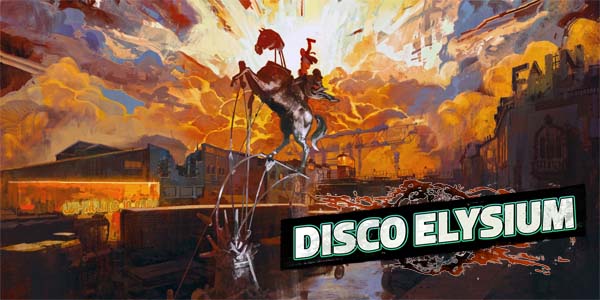
It's kind of hard to play a lot of video games while holding an infant child. It's certainly possible, but I had to accept that I was going to be less precise in my inputs whether I was holding a PlayStation controller or a keyboard and mouse. It seemed like a perfect time to try out a game that only requires a mouse to play -- a perfect time to finally try out Disco Elysium!
Disco Elysium is a unique and experimental RPG that straddles the line between RPG, point-and-click adventure, and walking sim. Most RPGs have combat of varying degrees of complexity in order to give all the various character stats and progression systems something to do. Disco Elysium completely eschews those conventions. I think I fired a gun maybe three times in my entire play time with the game (across a campaign and a half that I played prior to reviewing), and one of those gunshots was against a corpse hanging from a tree. Oh and I roundhouse kicked a a racist beefcake (you know, in order to establish my own racial superiority). Not exactly Call of Duty over here.
It may not require the twitch reflexes that many "gamer bros" expect every game to have, but games like this have been a godsend for those of us who only have one free hand to hold a mouse, because the other arm is holding a sleeping infant. It also happens to be a really good game.
I maybe fired a gun thrice, and roundhouse kicked a racist once, in 40+ hours of gameplay.
Inner dialogue
Instead of channeling character stats into gauntlets of filler combat encounters as a way of accumulating experience to improve those stats for the next combat encounters, Disco Elysium channels all of its character attributes into conversation trees. But these conversations aren't just with the other characters who I interview as part of the murder mystery plot. These conversations are also with the character's own inner monologue.
You see, the skills in Disco Elysium aren't like the skills of most other RPGs. They don't determine the character's physical strength, or agility, or skill with various weapons, or a blanket "charisma" attribute that determines if people believe your lies or are swayed by your arguments. No, instead, all of the skills of Disco Elysium represent elements of the protagonist's personality and psyche. Those skills will even pop up during dialogue and allow the character to have arguments or conversations with his own inner monologue. Each skill is like a voice in the protagonist's head, telling him what to do, or how to interpret the events he encounters. Each skill is sort of a character in its own right.
The character's skills talk to him, giving the player insight into the game world and current circumstances,
and also (sometimes flawed) advice about how to proceed.
I'm reminded of the psychosis voices of Hellblade: Senua's Sacrifice, with each voice shouting over the others trying to tell Senua what to do or telling her that she's worthless and can't do anything right. Except in Disco Elysium, the player can actually have conversations with those voices. You can talk back to them.
These skills will pop up from time to time as interjections during conversations to make observations about what is happening or to recommend specific courses or action or responses. It's also a great way of delivering exposition and ensuring that the player knows any relevant details that the character should know. But they aren't always completely reliable. Sometimes blindly following the advice of these skills can land you in trouble.
[More]
80bc8a20-3326-45b8-b069-a9aa846f0548|0|.0
Tags:Disco Elysium, Steam, PC, indie gaming, za/um studio, RPG, Estonia, point-and-click, walking simulator, skills, internal monologue, alcoholism, drug addiction, politics, union, strike, communism, fascism, nationalism, racism, sexism, liberalism, murder, mystery, police, crime
In the last post, I talked about how the COVID-19 pandemic affected me personally -- which [thankfully] was not much. This time, I want to present some of my thoughts and opinions on the response to the pandemic from a policy and societal perspective, as well as what I perceive to be the lessons that we (as a society) should have learned.
Some of the most essential workers in our economy are the ones who are paid the least. Health care workers, delivery persons, postal workers, grocery clerks, warehouse workers, restaurant workers, and so forth were the people who had to keep going to work because our economy and lifestyles would grind to a complete halt without them. The median wages among employed individuals in the United States is around $49k per year. Yet according to Salary.com, the average salary for a professional truck driver is only around $42k. Contract or gig drivers (such as Amazon couriers) make far, far less.
Restaurant and grocery store workers also make far less than delivery drivers, often earning minimum wage (or less than minimum wage if you also make tips). Those who maybe kept their jobs, but were reliant on tips were especially hurt during the lockdowns, due to a lack of business and in-person contact.
Low-paid delivery persons and fast food workers were essential,
and had to keep working while the rest of us stayed home and safe.
And then there's the healthcare workers, who were literally putting their lives on the line every day, helping to take care of sick people and possibly exposing themselves to infection on a daily basis. Registered nurses (usually employed in hospitals) make decent pay, but the majority of support staff in private clinics are not necessarily registered nurses. This includes receptionists, phlebotomist, clerical staff, and other assistants. As of 2018, medical support staff earned an average of less than $40k per year!
Remember, these are the people who, during a pandemic, were considered "essential" workers who had to keep working (while everyone else stayed home) in order to keep a bare minimum economy running, and to allow the rest of us to continue to go about our daily lives. When shit hit the fan, we didn't look to lawyers, or corporate CEOs, or hedge fund managers, or brokers, or realtors, or movie stars, or athletes. Aside from doctors, we didn't need any of the traditionally highest-paid classes of workers. We needed truck drivers, postal workers, warehouse workers, grocery clerks, and food service workers, and of course medical staff. So I hope you remember this next time you hear someone say that these workers deserve higher pay, or that minimum wage should be increased. [More]
34e3e0bb-c9fb-4f6f-bba1-e6b8fae740b2|0|.0
Tags:COVID-19, coronoavirus, flu, influenza, pandemic, work, work from home, social distance, healthcare, insurance, social safety net, universal basic income, essential worker, education, tele-education, domestic abuse, Child Protective Services, pollution, carbon dioxice, climate change, stock market, corporate culture, racism, Civil War, Confederate Battle Flag
So what the heck happened to Picard's dog?! Number One was my favorite character in the premiere, but then he completely disappeared from the entire rest of the show and hasn't even been mentioned since. Were his inclusions in the premiere nothing more than reshoots that were thrown in at the last minute, after much of the rest of the show had been scripted and filmed?
Picard's home was broken into and Picard physically assaulted. The dog was nowhere to be seen. Guess he's not much of a guard dog, huh? I don't even think Picard bothered to ask if Number One was alive after the attack. For all he knew, the Romulan assassins murdered his dog. There's also no tearful "good bye" when Picard has to leave the planet on a potentially dangerous mission, or talk of who might take care of the dog if Picard doesn't return. On the upside, at least the writers didn't kill the dog as an excuse to turn Picard into "space John Wick", in the same fashion that the TNG movies used Picard as a "space John McClane".
Then again, bringing up an idea or character, only to completely drop it by the end of an episode with no real exploration of the concept or character seems to be the modus operandi of Star Trek: Picard.
I gave a lot of leeway to the premiere. I even said that I want to "delight of having just watched a new piece of Star Trek media that I didn't hate". Well that lack of hatred didn't last long. Each episode of Picard just got progressively worse and worse.
If not for the fact that I intended to write a full season review, I would have stopped watching the show by episode 4.
What happened to Picard's dog, Number One? He just disappears from the show after the first episode!
Just as I feared, Star Trek; Picard isn't about the rights of androids or the moral imperative to provide humanitarian relief to refugees (whether those refugees happen to be Romulans or ex-Borg). These things are dominant themes, but they aren't what the plot or story is actually about, nor does it ever become the ultimate message of the show. I think the overall message was supposed to be to not let your fear and prejudice turn you into a genocidal monster, but even that happens in a lazy, eleventh-hour "twist" that I thought made no sense. The actual plot is about conspiracies to cover up the existence of robot Lovecraft monsters from another dimension, and to stop androids from inevitably summoning them to kill all humans. Yep, that's Star Trek canon now. Go figure...

In the meantime, the episode-by-episode (and minute-to-minute) scripting is trying too hard to be like Firefly or any other grungy sci-fi series from the past 20 years. Now, I love Firefly. I also praise The Mandalorian for taking cues from Firefly. But The Mandalorian is set in the Star Wars universe, which was always a grungy universe that contained lovable rogues and scrappy survivors. Star Trek has never been that kind of universe. It's the antithesis of that kind of universe. If I wanted to watch a dark and gritty cowboy / ronin space adventure, then I'll watch The Mandalorian, or I'll go back and watch Firefly or Battlestar Galactica again. Or I'll check out The Expanse or Dark Matter or Altered Carbon or Westworld, or any one of a dozen other sci fi shows that have come and gone in the past 20 years and have borrowed heavily from that same aesthetic. Or I'll play Mass Effect 3, which Picard seems to have blatantly plagerized.
I don't watch Star Trek for that. I watch Star Trek for thought-out, uplifting, cerebral science fiction about an optimistic future that I hope humanity eventually achieves.
... [More]
22e79e8f-9802-45a0-a54d-d7ce9a53f717|2|5.0
Tags:Star Trek, Star Trek: Picard, Jean-Luc Picard, CBS, all access, streaming television, Romulan, Borg, Hugh, Seven of Nine, Icheb, android, civil rights, refugee, future, poverty, racism
My biggest concern going into this new Twilight Zone reboot was with the hour-long format of its premiere. The first episode, "The Comedian" (which was available on YouTube for free as a preview of the show to come), was a bit overlong and dragged considerably in the second half. It had made its point by about halfway through, we could all see where the episode was going, and it insisted on going on for another 20 minutes despite not really having anything left to say.
OK, yeah sure, in the past I've complained about shows like Fox's Cosmos reboot being too short. Commercials cutting Niel DeGrasse Tyson's Cosmos reboot to only 45-ish minutes was simply not enough time for Tyson to give more than an elementary overview of the grandeur of nature or science.
However, The Twilight Zone isn't an educational show about "all that is, or ever was, or ever will be"; it's an anthology of science fiction parables and allegories. Parables and allegories are usually short and simple stories intended to convey a moral or lesson or insight into the human condition. The Twilight Zone doesn't really need a full hour to tell its stories. The twists are easy enough to see coming. This isn't The Sixth Sense, or Fight Club, or American Psycho, or Se7en, or something similar that actually needs a two-hour runtime to build up suspense and intrigue and dot the entire runtime with clues for its twist ending.
The pilot episode "The Comedian" felt over-long.
I was happy to see that episodes later in the first season have variable runtimes. The second episode, "Nightmare at 30,000 Feet" (which is actually a totally different story than the "Nightmare at 20,000 Feet" classic that it is homaging with its title), is under 40 minutes, filled out its runtime better, and enjoyed much tighter overall pacing. The following episode, "Replay", clocked in at 45 minutes, and also enjoyed a much tighter script.
... [More]
55a4fecd-3e7f-4cf2-be91-446004c60d06|1|4.0
Tags:The Twilight Zone, Jordan Peele, CBS, all access, streaming television, Rod Serling, science fiction, anthology, parable, allegory, racism, bigotry, toxic masculinity, date rape, social justice, social injustice, plot twist
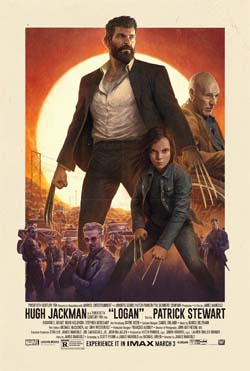
You've probably already heard this, but Logan is not a typical comic book movie. In fact, this movie feels less like a comic book movie, and more like a western combined with Terminator 2: Judgement Day and The Last of Us. This last analogy is particularly apt, considering that Logan deals with the extinction of mutants from the X-Men film universe.
The X-Men comics and movies have always been known for being topical, with their themes of racism, bigotry, and so forth, and Logan manages to to also be surprisingly topical regarding its storyline of a child fleeing [what amounts to] a violent drug cartel in Mexico, being unwelcome in the United States, and having to flee even further to Canada.
And this movie is laden with so much more possible metaphor. Logan's rejection of the comics' fallacious telling of events may symbolize our own need to let go of our childhood nostalgia regarding these fictional universes and characters and accept new and different interpretations. The final scene, with the child clutching the action figure, just so perfectly captures this bittersweet sentiment. And thank goodness that there isn't an end-credits scene, because I would have been pissed if anything had come up to ruin that perfect final shot. Or maybe it symbolizes the gradual and steady loss of our own real-world heroes. The last astronaut to walk on the moon died this year. We've lost civil rights leaders, WWII veterans are becoming increasingly rare, our 20th century pop culture icons are slowly kicking the bucket. What kinds of heroes will replace them? There's a lot to unpack here.
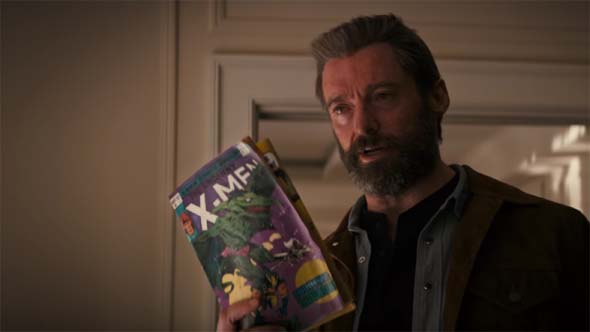
The X-Men are revered, mythical figures within the film's universe.
And by avoiding any strong, direct connections to other X-Men movies, Logan not only allows non X-Men fans to get into the movie without all the extra baggage, but it also kind of implies that maybe the previous movies aren't to be taken seriously either... [More]
dd2f0466-aa07-4b25-9194-8d7bc9888444|5|4.2
Tags:Logan, Wolverine, X-Men, Charles Xavier, Laura Kinney, X-23, Weapon X, mutant, comic book, Westchester, civil rights, racism, Hugh Jackman, Patrick Stewart, The Last of Us, Terminator 2: Judgement Day, western
|

| 12 | | | | | | | 60 | | 11 | | | | | | | 55 | | 10 | | | | | | | 50 | | 09 | | | | | | | 45 | | 08 | | | | | | | 40 | | 07 | | | | | | | 35 | | 06 | | | | | | | 30 | | 05 | | | | | | | 25 | | 04 | | | | | | | 20 | | 03 | | | | | | | 15 | | 02 | | | | | | | 10 | | 01 | | | | | | | 05 |
|