This past weekend, I put up my review of Gathering Storm, the new expansion for Civilization VI. The overall summary is that I felt very "meh" about the game's headline features, but was actually impressed by how the smaller, more subtle changes really improve the underlying game. That review focused on a lot of the high-level concepts of the game, and was already starting to get rather long (my readers all know how verbose I can be). I decided to cut a lot of my smaller criticisms of individual mechanics or functionality out of that review, and save them for their own separate post.
So now that you all know how I feel about the expansion overall, here's some of my smaller nags and nitpicks (and suggestions for resolving them) that I hope can be resolved by some post-release patches.
Table of contents
Civs who don't pollute should gain Diplomatic Favor
[More]
648e5396-2c29-4d24-8cbc-3a47e3e48539|1|5.0
Tags:Sid Meier's Civilization, Civilization VI, Civilization VI: Gathering Storm, weather, disaster, flood, world congress, diplomatic favor, strategic resource, oil, iron, coal, user interface
It's refreshing to see a video game (of all things) take seriously the second greatest existential threat to civilization (after nuclear weapon stockpiles), while governments (particularly here in the United States) fail to even acknowledge that it's real. I was honestly a little bit surprised to see anthropogenic climate change be the focus of an entire expansion to Firaxis' Sid Meier's Civilization VI. Firaxis has been playing very "politically correct" with the game in its past two iterations. Civ IV, if you remember, included slavery as a mechanic that allowed players to kill population in exchange for a production boost, and it included leaders like Joseph Stalin and Mao Zadong. Civilization III allowed collateral damage from city sieges that would kill population, destroy infrastructure, and potentially reduce wonders of the world to mere ruins. Civilization II allowed democratic congresses to overrule the choices of the player. And Civilization: Colonization actually required you to draft citizens from your cities into soldiers to fight wars.
Politically sensitive concepts like slavery, and characters like Joseph Stalin, have been in Civ games before,
but Civ V and VI have played things very safe and controversy-free with most of their content.
Civilization V and VI have dialed back from such concepts and leaders, as well as other "politically sensitive" topics in favor of diversity, inclusiveness, and a more rose-tinted vision of human history that tries to pretend that things like slavery, colonialism, opium wars, and the Holocaust didn't happen. I get it. They're going for a more optimistic vision of humanity that celebrates our achievements while overlooking the incalculable amount of [often unnecessary] suffering that came at the expense of many of those achievements.
So to see Anthropogenic Global Warming not only be included -- but to be the headline feature -- is surprising. I mean, I don't think it's a politically or culturally sensitive topic, nor should it be to anyone else if we lived in a rational world. It's the reality that we live in -- plain and simple. Nevertheless, it's a brave and important gesture from 2k and Firaxis. Anthropogenic climate change is certainly the second greatest threat to human civilization after our frightful stockpile of nuclear weapons -- or maybe an asteroid impact, but that is exceedingly unlikely to happen. It's an issue that needs to be a part of the cultural conversation, and it is perhaps the biggest price that we (as a civilization) are going to pay for the hubris of our unsustainable growth. It's a problem that every nation in the world needs to face, and solving that problem should be part of any game that attempts to simulate or systematize modern politics.
Anthropogenic climate change is one of the most serious problems threatening real-life civilization.
That is why I'm rather disappointed that the actual implementation of global warming in Civilization VI: Gathering Storm is a bit lackluster and un-apocalyptic.
The greatest existential threat to civilization is civilization
Climate change in Civilization VI: Gathering Storm just doesn't seem to be quite as devastating [globally] as it is in real life. Basically, raising the global temperature will have three effects.
- Increases the frequency of weather-related disasters,
- Melts polar ice caps,
- Floods certain coastal tiles.
Many disasters are trivially managed by leaving a builder or two (with 1 charge) to repair pillaged tiles.
The melting of the polar ice is actually a benefit, as it provides easier routes for naval units if canals aren't available or useable. The other two will cause problems for every player, but I've found them fairly easy to manage (at least on the Emperor difficulty that I usually play on). Disasters will typically pillage tile improvements and districts, but a severe disaster may also outright remove improvements, and may even kill points of population.
... [More]
4b253bea-180f-4b51-bee0-8ae99652603e|0|.0
Tags:Sid Meier's Civilization, Civilization VI, Civilization VI: Gathering Storm, weather, disaster, pollution, carbon dioxide, greenhouse gas, fossil fuel, climate change, global warming, flood, volcano, world congress, diplomatic favor, strategic resource, aqueduct, encampment, skirmisher, courser, cuirassier, pikeman
Civilization VI's new expansion "Gathering Storm" has been out for a week now, and I've been trying to play it as much as I can. There's a lot of new features, and several genuine attempts to change how the game is played -- with varying degrees of success. I wanted to take some time to share some of my initial experiences with the game, in the form of some tips that I have for playing with the new features and rule changes.
Disclaimer: I'm writing this less than a week after the expansion came out. I've only had a chance to play a few games, and I'm not totally well-versed or experienced with the new mechanics and rules. I may get some things wrong. If so, feel free to let me know in the comments!
... [More]
10bf71d4-887e-485e-8377-1b9a2eab2e7b|0|.0
Tags:Sid Meier's Civilization, Civilization VI, Civilization VI: Gathering Storm, weather, disaster, Liang the Surveyor, builder, dam, volcano, hurricane, tropical storm, drought, flood, tornado
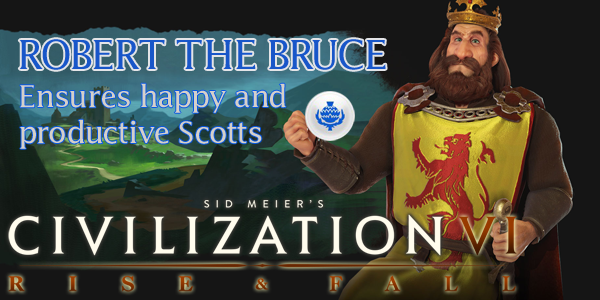
Civilization VI's second expansion, Gathering Storm was announced earlier this year, and will be released in a couple months. It will include modified rules and new civilizations, and I'll certainly be writing some guides for its new civilizations. In the meantime, however, I'm going to tackle one more civilization from the previous Rise & Fall expansion. This civilization happens to be the last of the "new" civilizations (a civ that has never appeared in a previous game): Scotland, lead by Robert the Bruce.

Scotland is currently a part of the United Kingdom, and makes up the northern third of the British isle. However, Scotland was an independent, sovereign kingdom throughout most of the Middle Ages. The lands of Scotland are shaped predominantly by receding glaciers during the tail end of the last ice age, and the area has been inhabited for over twelve thousand years. The Scottish Gaels strongly resisted Roman encroachment into their territory during the first and second centuries. Their raids on Roman forts forced emperor Hadrian to construct a defensive wall over 117 km long and as tall as 6 meters, that ran almost the entire width of the island. Parts of the wall still stand across England today. After the withdrawl of the Romans, the kingdom of the Picts became known as the kingdom of Alba, which flourished in the 12th and 14th centuries, possessing some of Europe's most influential philosophers.
In 1295, when Scotland's King John had refused to fight alongside England's King Edward against the French -- despite Edward having arbitrated the Scottish crown to John -- England and Scotland were plunged into war that resulted in England seizing control over Scotland. In the early 14th century, new Scottish King Robert the Bruce began a 20-year campaign against the English to restore Scottish independence. Victory at the battle of Bannockburn finally restored control of Scotland back to the Scotts, and conflict between England and Scotland continued off and on for many generations before the two countries were united diplomatically in 1707.
DISCLAIMER:
Civilization VI is still a "living game". Strategies for the game (and for specific leaders and civs) may change as Firaxis applies balance patches, introduces new features, or expands the game through further DLC or expansion packs, or as the Civ community discovers new strategies or exploits. As such, the following strategy guide may change from time to time. I will try to keep it up-to-date, and will make notations whenever changes are made. I'll also post links in the official 2K forums and CivFanatics, where I'll also report any changes made. If possible and practical, I will try to retain the original content of the strategy for posterity.
I welcome any feedback or suggestions that readers wish to offer. Feel free to post on the linked forums, or by posting a comment at the bottom of the page.
This guide is up to date as of the November 2018 "launcher" patch (ver. 1.0.0.262)
Scotland is another "world police" civ (similar to Australia). It can also hold its own and can become a technological and/or industrial powerhouse if its citizens remain happy.
[More]
4aff6e58-76c7-40e2-879e-064cb4e5c5c2|0|.0
Tags:Sid Meier's Civilization, Civilization VI, Civilization VI: Rise and Fall, Scotland, Scottish Enlightenment, Robert the Bruce, Bannockburn, golf course, highlander, flower of Scotland, ranger, amenity, happiness, housing, science, production, culture, war of liberation, casus beli, alliance, city state, unique improvement, unique ranged unit
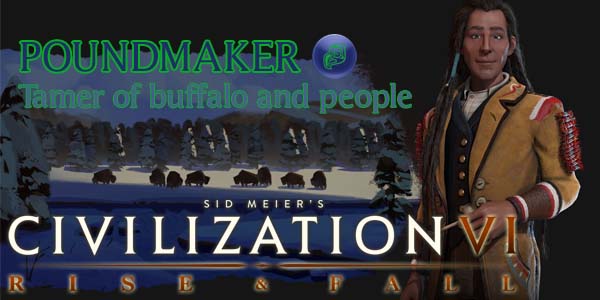
Civilization VI's first expansion, Rise & Fall released earlier this year, and it introduced a few leaders and civilizations that are making their first appearance in the franchise. I hope to be able to write strategies for every one of the expansion civs and leaders, but I'm going to start with the ones that are new to the franchise, and the ones that most utilize the expansion's new features (Era Score, governors, loyalty, and so on). This month, I will be tackling the Cree, lead by Poundmaker.
The Cree are a group of Algonquian-speaking North American First Nation hunter-gatherers. Their numbers have reached hundreds of thousands, and their territory has covered much of mainland Canada (stretching from Newfoundland all the way to western Alberta) and parts of modern-day northern Montana. They were divided into several subgroups based on region and dialect, but their social structure was mostly uniform. They grouped together into a "lodge" consisting of two families related by marriage. Several lodges would hunt and migrate together in a "band", with lodges routinely coming and going between different bands, or forming new bands.

As Cree bands migrated into the Great Plains, those bands began taking up buffalo hunting and herding. The leader of one such band, Pîhtokahanapiwiyin, became famous for his "divine" talent for using song and drum to attract buffalo into a walled pasture called a "pound". This talent, earned him the name Poundmaker from English-speakers. With the numbers of buffalo dwindling in the late 1800's, Pîhtokahanapiwiyin lead his people to Battleford to reaffirm his loyalty to the Queen and to negotiate for food and supplies. The townspeople, fearing an attack, holed up in the fort for several days, refusing to speak to Poundmaker, even though a spy had verified Poundmaker's peaceful intents. Canadian troops arrived a month later and attacked the Cree. The Canadians were routed, but Pîhtokahanapiwiyin ordered his warriors not to pursue, as he did not want a massacre. Despite not having instigated the conflict, Pîhtokahanapiwiyin surrendered to authorities in order to avoid further bloodshed. He was convicted of treason, and sent to prison. His sentence was only for seven months, but he died shortly after release due to a lung hemorrhage that he suffered in prison.
Pîhtokahanapiwiyin's actions, and his many alliances with other native tribes, and treaties with the Canadian government, have earned him a reputation as a skilled negotiator and a man of peace and wisdom. Today, the descendants of Pîhtokahanapiwiyin and his band live in the Poundmaker Cree Nation, a reservation in Saskatchewan, which was founded by Pîhtokahanapiwiyin himself.
DISCLAIMER:
Civilization VI is still very early in its life-cycle (particularly the Rise & Fall expansion. Strategies for the game (and for specific leaders and civs) may change as Firaxis applies balance patches, introduces new features, or expands the game through further DLC or expansion packs, or as the Civ community discovers new strategies or exploits. As such, the following strategy guide may change from time to time. I will try to keep it up-to-date, and will make notations whenever changes are made. I'll also post links in the official 2K forums and CivFanatics, where I'll also report any changes made. If possible and practical, I will try to retain the original content of the strategy for posterity.
I welcome any feedback or suggestions that readers wish to offer. Feel free to post on the linked forums, or by posting a comment at the bottom of the page.
This guide is up to date as of the July 2018 "Red Shell" patch (ver. 1.0.0.262)
Poundmaker had front-loaded bonuses that encourage him to be a trade-based peacemonger in Civilization VI: Rise & Fall, who gains additional bonuses from trade routes (either domestic or foreign) with cities that contain camps or pastures...
[More]
fc0ccceb-184d-4d57-905e-2ea1f5986234|1|5.0
Tags:Sid Meier's Civilization, Civilization VI, Civilization VI: Rise and Fall, Cree, Nehiyawak, Poundmaker, Pihtokahanapiwiyin, Nihithaw, favorable terms, iron confederacy, okihtcitaw, mekewap, alliance, trade route, trader, pottery, food, gold, production, camp, pasture, resource, housing, Canada, first nation, unique improvement, unique recon unit
|

| 12 | | | | | | | 60 | | 11 | | | | | | | 55 | | 10 | | | | | | | 50 | | 09 | | | | | | | 45 | | 08 | | | | | | | 40 | | 07 | | | | | | | 35 | | 06 | | | | | | | 30 | | 05 | | | | | | | 25 | | 04 | | | | | | | 20 | | 03 | | | | | | | 15 | | 02 | | | | | | | 10 | | 01 | | | | | | | 05 |
|