The biggest piece of video gaming news this past week was Sony's announcement that it would end production of physical game discs in January of 2028. This won't just affect any potential upcoming PS6 console. This decision will affect future PS5 games as well, which as of 2028, will no longer be available in physical disc formats.
If it were just a simple matter of transitioning from ownership of physical media to ownership of digital media, I would be all for it!
Games being digital only would mean that publishers wouldn't have to mine for materials, pollute the environment with manufacturing discs, or burn gasoline (and emit greenhouse gases) from having to transport those discs across oceans and continents to retailers. It also means they won't end up in landfills. These would all be positive changes for the environment, which I think would outweigh the downfalls of physical discs being un-available. The biggest problem with digital-only ownership would probably be distribution for people with limited (or no) internet access. I do think that is a problem which should be addressed. Poor rural gamers deserve to be able to play new games too. But a digital-only ownership model would be, I think, a net positive.
The problem, of course, is that Sony (and other media companies) are not switching to a "digital ownership" model; they are forcing consumers into a license-leasing model. They are stripping away consumers' right to own the media we purchase. All digital purchases can be revoked from our libraries at any time, for any reason (or for no reason at all), completely at the whims of our wannabe corporate overlords. Worse yet, as far as I can recall, courts have generally upheld that "buying" a digital good is, in fact, a temporary lease of a license. I did a quick Google search for a case precedent, but couldn't find anything specific. So take that with a grain of salt, but I remember reading about some case in which Amazon (or somebody) won a lawsuit involving the revocation of digital purchases.
In fact, California is further codifying this with a consumer protection law that requires retailers to clearly disclose that the customer does not own the media they are buying. This sort of disclosure is good, but I think what the laws should be doing is codifying that the consumer does, in fact, own the purchases media, and that the retailer cannot prohibit the consumer from copying or preserving the media for personal use. But we live in a corporate dystopia that only cares about protecting corporate profits instead of the rights of the public. [More]

Civilization VII is right around the corner. For the first time in the Civilization series' history, it will actually have competition in its specific niche. One of those competitors is Microsoft's Ara: History Untold. Of the various games in the "historic 4x grand strategy" genre, Ara might very well be the most unique -- both to its benefit, and also to its own detriment.
Part Civilization, part city-builder
In addition to the obvious comparisons to Civilization, Ara: History Untold feels almost as much like a medieval survival-village-crafting game along the lines of Banished, Settlement Survival, or Manor Lords. The bulk of the game is spent building resource harvesters, building crafting buildings, and then trying to set up an efficient and self-sufficient economic engine that converts those harvested resources into manufactured goods. As you research new technologies and advance through the eras, you'll unlock new resources and recipes for new things you can craft with those resources. In fact, most of the tech tree is dedicated to unlocking new resources and craft recipes.
There is a huge variety of resources and manufactured goods.
The limited space available to each city will prevent you from ever really feeling like you've built a perfectly efficient machine. There's enough different crafting buildings, enough different resources, and enough different crafting recipes that you won't have enough room to build all the collectors and crafters for everything. So you'll be switching what crafting building is crafting what goods periodically, as certain infrastructure or units may require specific goods. Goods can also be assigned to buildings in order to "accelerate" their crafting efficiency, or to the cities directly in order to satisfy the needs of the population or to provide passive buffs.
For example, if you build a butcher shop in one of your cities, you can assign it to craft either salted fish or salted meat. If you choose salted meat, then you can assign a cow, pig, or venison, as well as optional salt or spices in order to speed up the production of that meat. You can then take that crafted meat and assign it to a city to provide extra food for the population.
Similarly, you can harvest raw iron ore from mines, process them into ingots in a forge, then combine the iron ingots with coal in a foundry to produce steel. That steel can then be used to create everything from skyscrapers to house more population, to luxuries like consumer automobiles and refrigerators, to tanks and battleships.
Candles can be equipped into housing to improve the knowledge rating of the residents.
And there are so many things that you can craft. There's candles, furniture, pottery, linen, medicinal herbs, pastries, coffee, microchips, and so forth. These sorts of items can be assigned to other buildings to provide certain passive benefits. A candle, for instance, can be assign to a residential dwelling to increase the "knowledge" rating of the city, which speeds up your technology research rate. Presumably, the people living in that dwelling are using the candle light to study books and learn things through the night. Similarly, metals, glass, and fuels can be used to craft lampposts, which can be installed in cities to reduce crime and improve the city's security rating.
[More]
72487ed9-f255-456f-9bdc-732afdfc5561|1|3.0
Tags:Ara: History Untold, Microsoft, Microsoft Game Studio, XBox Game Studio, Oxide Games, strategy, 4x, history, economy, crafting, resource, logistics
Over the years, I have frequently recommended that people stop buying new games from AAA publishers at retail. Don't buy them at all, or if you do, wait for a sale, or buy it used. This is because the massive, international, conglomerate corporations that publish these games are sleazy, scummy, or outright evil.
They underpay their employees.
They abuse their employees with cultures of crunch.
They hang the Sword of Damacles over their employees heads with the perpetual threat of layoffs.
They report record profits to their shareholders and award billion dollar bonuses to executives on a Tuesday, and then lay off hundreds or thousands of workers on Wednesday because they "can't afford" to keep them.
Some publishers even have active cultures of sexual harassment and abuse of female employees, which their HR departments are happy to cover up or sweep under the rug.
They harass and ostracize transgender employees and hold their healthcare hostage.
They fight against unionization.
They overcharge for their products.
They sell un-regulated gambling to minors.
They sell half-baked or broken products at full price.
They cancel promising upcoming products with little-to-no rhyme or reason.
They want to take away the consumer's right to own the media that we buy.
The list goes on... [More]
860f709e-321c-4ad2-9fc6-ec6ece4e056d|2|4.5
Tags:Microsoft, Tango Gameworks, Arkane, Alpha Dog, Roundhouse Games, Bethesda, Sony, Japan Studios, retail, corporate culture, corporation, Activision, Blizzard, Ubisoft, Nintendo, Konami, Annapurna Interactive, From Software, Electronic Arts, EA Sports, Japan Studio, eBay, Hi-Fi Rush
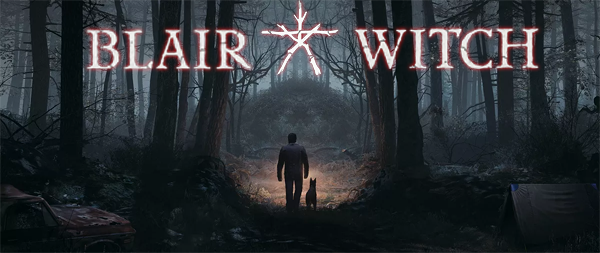
Blair Witch, as an intellectual property, is in a frustrating place similar to the Alien franchise. Both were innovative horror films that set numerous standards and conventions within their sub-genres, and which have been copied and ripped-off numerous times. Sci-fi games from Starcraft, to Metroid, to System Shock, to Dead Space have all taken heavy inspiration from Alien and Aliens. So much of the iconography of Alien and Aliens have been borrowed by these games, that when someone comes along with a game based on the Alien intellectual property, it's hard for that game to not feel like it's derivative of one (or all) of the myriad Alien impersonators.
the Blair Witch Project has similarly left a mark on the horror landscape. It single-handedly popularized the "found-footage" genre against the backdrop of a creepy, supernatural forest. Games such as Outlast, Alan Wake, and even Resident Evil VII all have a little bit of Blair Witch in their DNA. So when a game comes out that actually bears the "Blair Witch" name, it's kind of hard for it to stand out in the larger horror landscape.
Plenty of games (such as Outlast [LEFT]) have used tropes inspired by The Blair Witch Project.
This is the case with Lionsgate and Bloober Team's new Blair Witch game, exclusive to Microsoft platforms. Nothing that Blair Witch does feels particularly new or creative, even though most of the game's ideas are competently executed. Using a camcorder as a tool for navigation, exposition-delivery, and puzzle-solving feels pulled straight from Outlast or Resident Evil VII. Wandering through the woods and defeating monsters by pointing a flashlight at them gives me flashbacks to Alan Wake. Navigating the forest and occasionally picking up other people's trash also reminded me of Firewatch. Eventually, the whole game descends (rather predictably) into P.T. territory -- but, you know, without all the nuance or careful pacing that made P.T. so unnerving.
Who's a good doggy?
Blair Witch's most innovative feature is probably the dog companion (named Bullet), but even that feels pulled straight from Fallout 4. I probably would have been a bit more impressed if not for the fact that Bullet seemed to lose relevance as anything other than a monster compass, for a large chunk of the middle of the game. Without having healing items or ammunition or any other consumable supplies, the ability to send the dog out to find things feels like a sorely under-utilized mechanic.
Bullet is very well-introduced, and is integral to the early levels of the game. He finds clues for you, fetches key items, guides you to the next objective, and warns you of potential danger, all completely organically and without breaking immersion. But after a couple of hours, he just runs out of things to find and things to do. The puzzle shift away from using the dog, and more towards using the camera to do everything from manipulate the environment, to navigate mazes and looping paths, and even spotting monsters.
Your emotional support dog, Bullet, serves an integral role throughout the game.
... [More]
7a3b2c59-d35b-424f-a1cd-ecf04d6332bb|1|5.0
Tags:Blair Witch, Bloober Team, Lionsgate Games, The Blair Witch Project, Microsoft, XBox, windows, XBox Live, Steam, Good ol' Games, indie gaming, horror, found-footage, camera, forest, post-traumatic stress disorder, dog
It's tax season, which is not something that I ever write about on this blog. But this year, I had a very irregular experience. It wasn't with my taxes; rather, it was with my dad's attempts to use this year's TurboTax software. He'd been using TurboTax for years with no problem, but this year, the program wouldn't install. He's not exactly tech-savvy, so he had to call me to help him troubleshoot.
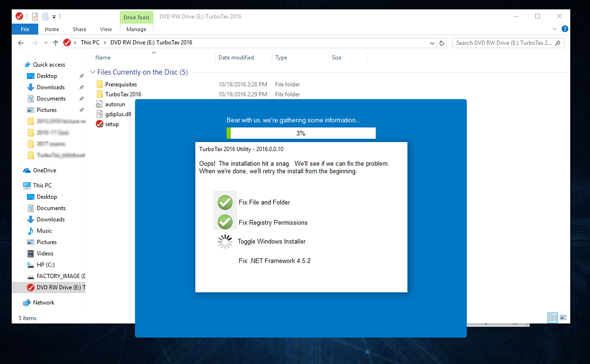
TurboTax fails to install due to some unspecified issue with the .NET Framework.
Upon attempting to install the program, he gets a very un-descriptive error message that simply states there was a problem installing TurboTax. Then a dialogue pops up stating that TurboTax is attempting to fix the problem by checking the file system, registry, and .Net framework. It's the .Net Framework step where TurboTax fails with yet another very un-specific error.
We tried updating Windows, disabling anti-virus software, and even opened up the registry to make sure that all the requisite versions of .Net Framework were installed. No luck.
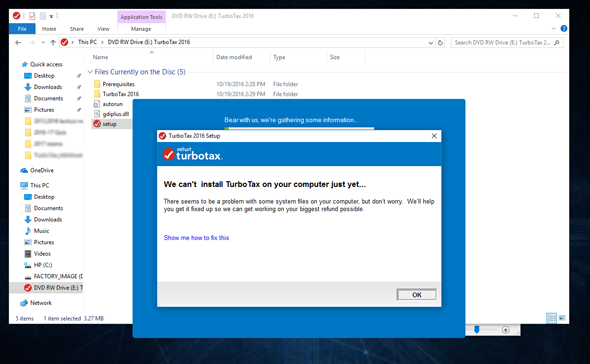
Unable to resolve the problem itself, TurboTax referred us to a troubleshooting web page.
TurboTax referred us to this troubleshooting page, which includes instructions for downloading and running various .Net Framework repair tools and other system file integrity tools. In my dad's case, none of this stuff worked. As a last resort, the troubleshooting guide referred me to a blog post by Microsoft developer Aaron Stebner, who wrote about a .Net Framework cleanup tool that could potentially be used to resolve the issue... [More]
90a849db-87db-4a02-a5e5-9c7105a6911c|3|5.0
Tags:Intuit, TurboTax, Microsoft, Windows, Windows 7, Windows 10, .Net Framework, PC, taxes, troubleshooting, customer support, Aaron Stebner
|

| 12 | | | | | | | 60 | | 11 | | | | | | | 55 | | 10 | | | | | | | 50 | | 09 | | | | | | | 45 | | 08 | | | | | | | 40 | | 07 | | | | | | | 35 | | 06 | | | | | | | 30 | | 05 | | | | | | | 25 | | 04 | | | | | | | 20 | | 03 | | | | | | | 15 | | 02 | | | | | | | 10 | | 01 | | | | | | | 05 |
|