
With the 100th anniversary of "The War To End All Wars" having been in the last decade, there's been a little explosion of games in various genres that have been set in World War I. World War I survival horror games have actually started to become their own special little sub-genre, with stand-outs like Amnesiaa: The Bunker, Ad Infinitum (which I have not yet played), and the subject of this review, Conscript, as well as a few other smaller titles. World War I is such a brilliant thematic setting for a survival horror game, that it really does kind of surprise me that nobody thought of this before.
First and foremost, World War I is often considered to be a tragic war. It was fought for stupid, asinine reasons, with no clear good guys or bad guys, and the loss of life ultimately ended up being even more pointless than usual for a war. It was also the first war to employ horrific new industrial weapons that multiplied the pain, suffering, and death compared to every war previously fought. From machine guns, to tanks, to airplanes, to the various gases that were so horrific that they were banned by the international community in the fallout of the war. And more superficially, the trenches and bunkers that are an iconic part of the imagery of the war are tight, enclosed, and claustrophobic spaces that are dark, dirty, and full of death, rot, and vermin. All of these circumstances and aesthetics of the war combine to make it an ideal thematic setting for horror -- in retrospect.
Conscript may be the ultimate realization of the war as a horror setting. Conscript is grounded and presents the war as horrific in its own regard. Unlike Amnesia, Conscript doesn't really rely on supernatural monsters or Eldritch gods to try to make the war scarier than it already is. It's just you, the trenches, and an army of German soldiers between you and survival. And survival will not come easy!
The trenches of World War I are an inherently horrifying setting.
Saving Private Piérre
The basic setup of Conscript is a little evocative of Saving Private Ryan. You play as one of a pair of brothers conscripted into the French army to defend Fort Souville and prevent the Germans from capturing the town of Verdun. On the way to the front lines to defend from a German advance, you find your brother critically injured and unconscious. During the skirmish, you are injured and left for dead while the rest of the French army retreats and temporary abandons the fort to regroup for a counter-attack. After waking from your injuries alone in a corpse pit, you find that the trenches are slowly being overrun by German troops, your brother is missing, and the player character vows to find him and protect him, so that you can both return home to your mother.
This leads the player to start exploring the maze-like web of trenches connected to Fort Souville in search of your brother. Locked doors and other obstacles block progress, in typical survival horror fashion, and you'll have to scavenge for whatever supplies you can find to help defend yourself from the German soldiers who have started occupying and patrolling the trenches and fort.
In classic survival horror fashion, doors will be locked by themed keys or puzzles.
The game is played from a top-down perspective, with pixel-art, which also limits your visibility and awareness of what is around you (also in typical, classic, survival horror fashion). Aiming and firing a weapon is slow and cumbersome, and the weapons must be manually reloaded after every shot. There are no zombies or monsters; just human German soldiers. At first, they will be easy to kill with a single shot or two from your rifle or shotgun, but within a couple hours of play, you'll start running into tougher, armored shock troopers that will require multiple shots to take down. The slow nature of firing and reloading your weapon means that enemies charging you at melee are far more threatening than you might expect. "Never bring a knife to a gunfight" you might say? Well, not if the gun is a World War I rifle, it seems. Furthermore, any time you are up against multiple enemies, it will turn into a desperate scramble to keep distance from the melee troops and find cover from riflemen within the tight confines of the trenches.
Bandages and first aid kits are also in short supply. Every bash that you take from a German trench baton, or graze from a rifle shot, will whittle down your health and ratchet up the tension, as you can ill afford to take more hits. The game will provide more healing items later on (as well as ample opportunity to craft more), but health recovery will always feel tight. I finished the game with [I think] only 2 healing items remaining in my item box; though, I could have bought the ingredients to craft a few more, if I absolutely needed to.
You'll need to be paying attention to what you're doing, and have fast reflexes to either dodge surprise enemy attacks, or quickly dispatch them. The enemies here won't insta-kill you like in a hide-and-seek horror game. You have a health bar, and can take quite a beating. The Germans, however, will be more than happy to dish out those beatings if you give them an opportunity. A single screw up won't get you immediately killed, but sloppy play can quickly turn fatal, as even the most basic grunts can be lethal if you get careless and expose yourself to multiple attacks.
All of this is near perfectly encapsulated by the exceptionally-designed and stressfully-paced opening chapter or 2 of the game. All of the game's best ideas and mechanics really shine in these first few hours and left me with an immaculate first impression of the game. But by the mid-point of the game, nags and nitpicks did start to pile up. [More]

Amnesia: The Dark Descent almost single-handedly popularized the "hide and seek" and "run away" sub-genres of horror that would go on to influence everything from Outlast to >Observer_, and even the likes of P.T. and Visage (though I'm always surprised to remind myself that Silent Hill: Shattered Memories actually preceded Amnesia by a whole year). Amnesia also remained one of the more mechanically complex horror games, as more and more horror games leaned harder and harder into the paradigm of the "unarmed, defenseless player character" and erred closer and closer to walking sims. But even though Amnesia retained more mechanical complexity and more genuine threat than its contemporaries, it (and its sequels) never hit the level of complexity and action of a classic survival horror game.
Survival horror seems to be going through a renaissance of late, thanks in large part to Capcom hitting it out of the park with most of recent Resident Evil games. As such, Frictional Games wastes no time in telling the player that Amnesia: The Bunker ain't no walking sim. This is a return to old-school survival horror, but with modern conventions and twists. I have not been this impressed or excited by the opening hour of a survival horror game since booting up Resident Evil VII for the first time.
Death from German machine guns? Or death from an eldritch Beast? Take your pick.
Bullets and draw strings
Within the opening minutes of Amnesia: The Bunker, the player is dropped into a World War I trench with nothing but an empty revolver. There's no HUD at all. In order to check how many bullets you have in the revolver, you have to open the cylinder and look at how many bullets are left. To reload, you have to open the cylinder, drop out the empty shell casings, and manually reload each new bullet one at a time. Aiming and firing the gun is slow, clunky, and imprecise. There is also an ability to lean around corners and aim the gun.
After a short gun fighting tutorial in which the player is scripted to take damage, the game hands us some cloth with which to craft bandages. So the player has actual health, instead of just automatically healing over time, or losing sanity.
Then the game gives the player a flashlight. But unlike other contemporary horror games (or The Dark Descent), this flashlight doesn't run on batteries or oil. It has a simple friction motor that is recharged by repeatedly pulling a drawstring. Apparently, nothing in this game is going to be simple or effort-free. I do have to say though, that I wish the flashlight charge would last longer. Fumbling around in the dark to charge the flashlight (and risk making noise that could attract an enemy) is a wonderfully tense and anxiety-inducing mechanic, but having to do it every minute or 2 (whether there are threats present or not) gets tedious and annoying real quick. The fact that the light has to be recharged multiple times to explore a single moderately-sized room at a modestly brisk pace should have been a red flag that the light doesn't last long enough.
The flashlight and revolver require deliberate engagement from the player to use.
And then, if this weren't already feeling like a real survival horror game, within an hour of starting, you'll wander into a save room, complete with an item storage box and a map showing objectives and puzzle locations. One could easily mistake this for Resident Evil. Below the save room is a gasoline generator, which burns fuel to keep the bunker's electricity and lights running. But the supply of oil is limited, and spread throughout the bunker. And a warning sign is printed next to it, saying that the "beast" prefers to hunt in the dark. Keeping this generator running is one of the key mechanics of the game, since it (not your flashlight) is the primary source of light, and also the primary defense against the Beast.
This opening hour or 2 is so perfectly exactly what I want in a horror game! It is slow, tense, and methodical. I'm 2 hours in, and I haven't even seen the monster yet; I've only heard its threatening growls and the sound of it scuttling around within the walls and ceiling, seemingly ready to pounce at any moment. The game is already mechanically rich and varied, and full of risk / reward mechanics. Light and sound are both thematic effects and also full-fledged mechanics with strategy associated with them. It has an ever-present sense of dread and danger. The existence of the save room and item box suggests actual stakes for failure, and the presence of healing items and fuel suggest that the battle against this Beast will be one of attrition. It's looking to be a modern take on classic survival horror from one of the studios that innovated modern horror gaming.
Can I just give it an A+ already and start singing its praises on social media and YouTube? Well, let's actually play it and make sure. You know, just for shits and giggles. I mean, I haven't even seen the monster yet, so I should probably get at least that before I make up my mind, right?
The opening hours feel like pitch-perfect, classic survival horror.
[More]
1bdf3baf-4cce-48f8-bf09-155341cd0428|14|3.3
Tags:Amnesia: The Bunker, amnesia, Frictional Games, survival horror, horror, PS4, Steam, World War I, trench warfare, save room, revolver, flashlight, stopwatch, puzzle
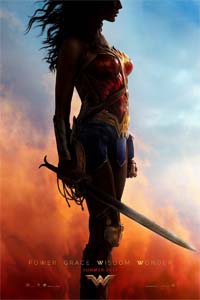
In their single-midned insistence on making all of their movies about epic showdowns between the superheroes and some big bad guy, the DC movies have consistently failed at depicting their heroes as having any particular desire or inclination to actually help people. This is perhaps the greatest failing of the Zack Snyder / Henry Cavill Superman movies and the greatest strength of the classic Richard Donner / Christopher Reeve Superman films: Snyder's / Cavill's Superman seems to treat saving people as a begrudging chore that he's obligated to do; whereas the classic Donner / Reeve Superman put on a charming smile and went out there to do good for the sake of doing good, simply because he is capable of doing good.
Well now, DC seems to have finally realized that the primary role of its superheroes is to be idealistic saviors and protectors. For the first time in the DCEU movies, our hero shows the idealistic optimism and desire to help people and do good that has been the trademark of the classic Superman films and the Spider-Man films (heck, even Amazing Spider-Man 2 got that right). But in this case, our hero isn't Superman or Spider-Man; our hero is Wonder Woman.
I actually don't mind the darker aesthetic and tone that DC has adopted for its movies. The problem so far has been that those movies have been dark and poorly-written and thought-out. Wonder Woman, on the other hand, is a much brighter movie (both in terms of visuals and thematic tone), and benefits from much tighter writing. The script is solid and tightly-themed, Wonder Woman has a full and nuanced character arc, the performances are good, the action looks slick, and (most importantly) it's easy to follow along with what's happening.
The biggest failing of the Zack Snyder / Henry Cavill Superman is that he seems to be begrudgingly helping people,
instead of happily doing good for the sake of doing good (as in the Richard Donner / Christopher Reeves Superman).
Gal Gadot provides a great performance that proves that her stealing the show in Batman v Superman wasn't just a fluke or a simple sign of how bad the rest of that movie was. She actually works well in this role and is almost as charming a Wonder Woman as Christopher Reeve was at being Superman. The supporting cast mostly works, and this is probably the best role that I've seen for Chris Pine to date. Some of the secondary characters are a bit under-written and lack screen time, but everyone (no matter how minimal their screen-time) has a role to play that helps shape Diana as a character. There's no superfluous characters like Louis Lane in either of Snyder's Superman movies. The only exception being, maybe, Steve Trevor's secretary, who actually deserved a lot more screen-time that she received.
Even Doctor Poison seemed to have a little bit of complexity and nuance to her character. She does suffer from some poor, underwritten motivation, as the movie never really seemed to go too deep into why she's doing what she's doing. But it's definitely apparent that there's something going on under the surface, beyond simply being manipulated by higher forces. The closest that I could figure is that she has some kind of relationship with General Ludendorff and is blindly loyal to him, but she at least wasn't a bad guy for the sake of being a bad guy.
Hits and misses
The only major weakness of Wonder Woman, as a movie, is that it's a bit of an uneven work. It's broken down into a readily discernible three-act structure. The first act is great, the second act is okay, and the third act sinks towards the DC stamp of terribleness. The unfortunate thing about this is that I walked out of the theater with a bad taste in my mouth, even though the movie was still mostly pretty good. So far, DC's movies have all started out mediocre and progressed towards terrible by the end. Wonder Woman, however, starts out good and starts to sink in the direction of bad at the very end. Which, I guess is a big improvement.
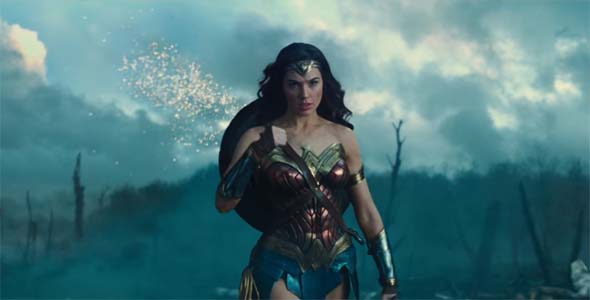
Act II concludes with Wonder Woman getting her first real "hero shot" in the movie.
The first act, set on the island of the Amazons, is colorful and vibrant. It's beautifully shot, with interesting and well-choreographed action sequences, and sprinkles of humor. If you didn't know better, you might be justified in mistaking it for a Marvel movie... [More]
40842c3b-0456-4b21-81c3-4fd9a6e449a8|0|.0
Tags:Wonder Woman, DC Comics, Gal Gadot, Diana Prince, Doctor Poison, Steve Trevor, Zeus, Ares, God of War, Amazon, Chris Pine, World War I, Germany, trench warfare, chemical weapon, mythology, Patty Jenkins, Zack Snyder
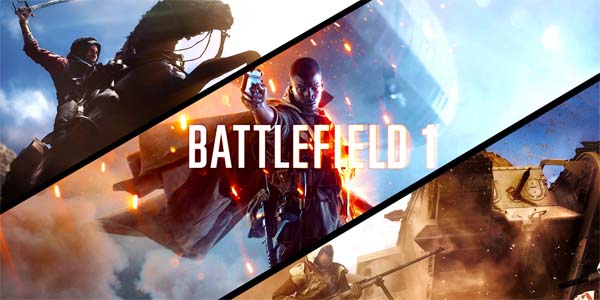
Nobody can make a game about World War I. Trench warfare is too boring. Nothing really happens. There isn't a strong, identifiable villain or good versus evil struggle.
Those are among the many excuses that people made for why all the video games are about World War II, and never about World War I. And then the gaming public and journalists got a glimpse of this:
The teaser trailer for Battlefield 1 was a smash hit.
That teaser trailer was damn good. People were excited. I haven't played a first-person shooter since Call of Duty: World at War, I generally hate online shooters, but even I was excited to try out this game! And other people were hyped about it too.
Now, I never really bought into the idea that World War I was "not video game material". I've long advocated for games to look at all periods of history for inspiration, and World War I is a monumental moment in world history that certainly deserves to be examined by games. The indie market certainly realized this, with games like Valiant Hearts and Verdun. But the big publishers have completely shied away from "The War to End All Wars".
This is a shame. The rapid technological advancements and radically new military tactics that evolved leading up to (and during) the war could be great material to examine in the form of a game. The widescale industrialization of warfare, the complicated politics, and the general fuzziness of the morality of the war are also ripe source material for dramatic storytelling. So it's about time to see this war thrust into the mass market spotlight.
I'd prefer to have seen a strategy game along the lines of Total War; but whatever, I'll give DICE and Battlefield 1 a chance.
UPDATE: 12 MARCH 2018, Better than I gave it credit for:
After having played Activision's Call of Duty: WWII and (especially) EA's Star Wars:
Battlefront II, and having talked about it with friends, I have gained a bit of respect for the successes that Battlefield 1 has been able to accomplish. I've started to like it more in retrospect. Not enough to go back and re-play it or try out any of the expansions (yet), but I do feel that I may have been a bit too harsh on the game in retrospect, especially with regard to its campaign vignettes.
I'm not going to change my original review score, but compared to CoD:WWII and Battlefront II, this game probably deserves a slightly higher grade. So keep that in mind as you read the following review. Of all the big-budget first person shooters that I've played in the past couple years, Battlefield 1
is probably the one that I most enjoyed, and it's the one that I would recommend.
The futile indifference of war
First impressions were actually pretty damned good. I was actually really impressed with Battlefield 1's campaign tutorial. It's basically a guided tour of the game's various core mechanics: shooting at enemy soldiers, capturing victory points, piloting vehicles, and so forth. It does a good job of introducing each of these mechanics and systems by jumping the player around between multiple characters in a large-scale battle.
But what really stuck out to me was how the tutorial transitioned between these different set pieces, and how it handled player death. This tutorial is actually surprisingly merciless and difficult. As you complete one set piece, the game gradually (and subtly) increases the threat until it becomes overwhelming and your character dies (or they just kill you after a timer expires), which allows the game to teleport you to the point of view of another character for the next set piece. The dying character's name and birth / death years are shown on screen during the transition, granting that character with a certain degree of humanization.
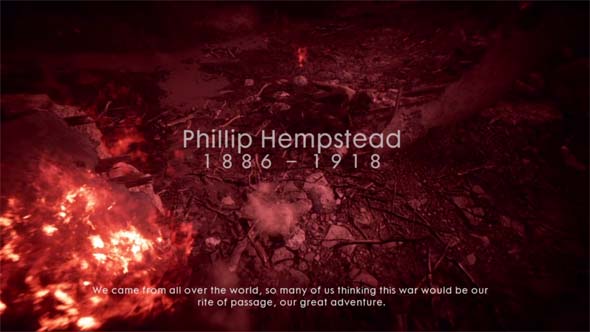
The excellent tutorial emphasizes the indifference and futility of "The War to End All Wars".
Depending on how good you are at the game, you'll go through between half a dozen to a dozen different characters, each with a name and an age. And they all die. The tutorial makes this war look brutal and futile. It even has an almost Dark Souls-like indifference to the player character, killing you without a second thought and forcing you to respawn as another poor, dumb bastard who's about to die for his country, rather than restarting you at a checkpoint until you get it right.
I even wish DICE had gone a bit further by also displaying the character's birth place and maybe even a snippet or two of other biographical trivia. Maybe listing some hobbies, or saying that he was on his high school's varsity football team, or some other little detail like that. DICE settled for just the name and birth / death year, but it's still effective and establishes a very strong running theme throughout the tutorial. The point is a bit undercut by the rapid pacing and by how conventional the actual running and shooting feels. But I still walked out of this tutorial excited by what the rest of the campaign had to offer. [More]
1b3222c5-df25-48fc-8292-199702831456|1|5.0
Tags:Battlefield 1, Battlefield, EA, Electronic Arts, DICE, PC, mouse & keyboard, EA Origin, shooter, online, multiplayer, World War I, war, history, trench warfare, chemical weapon, Harlem Hellfighters, tank, biplane, horse, England, France, Germany, Ottoman Empire, Europe, Argonne Forest, Arabia, Laurence of Arabia, eBay
Without a decent, new iteration of SimCity for me to play, I've been looking high and low for new city simulator games in order to scratch that particular itch. I spent a large chunk of time a few years ago playing Cities XL, but never got around to reviewing it (maybe I'll post aretro-review in the future). Cities XL has so far been the best of the bunch and has a very wide scope, but it's developer has folded, and the game has never truly felt complete.
So I've started looking at more niche titles. I gave Children of the Nile and Caesar IV a go a few years ago, and both were pretty good, but just didn't hold me over for very long. So when Tropico 5 went on sale on Steam, I picked it up and put it on the shelf till I took a break from Civ. The game has also been released on XBox 360, and it has also been announced for a PS4 release sometime in 2015, but I've been playing the PC version.
The primary gimmick of the Tropico series is that the player isn't a mayor (as most city simulators claim); instead, you play as a dictator who is granted governorship of a small Caribean island-nation by a European power. It's basically a Cuba-simulator. At the start of a game, you must create a dictator avatar, and that character can have children and heirs in order to maintain your dynasty. From a meta standpoint, this gives much greater justification for the breadth of power that the player has over the development of the city. But this dictatorial theme isn't just a gimmick; the game actually does use it for gameplay purposes.
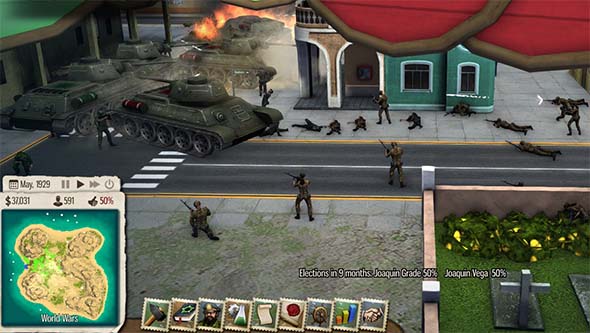
Poor management of relations with internal factions and external nations
can lead to revolts and open warfare on your streets.
In addition to balancing workers versus jobs and various citizen satisfaction metrics, the player also has to worry about maintaining your position of power and dealing on the international stage. Much like the Democracy games, the player actually has to win elections in order to avoid losing the game, and so you must balance the favor of various competing factions. It's nowhere near as deep as Democracy, since there's only about four factions (which change depending on the current era), but it does add an extra challenge that a game like SimCity lacks. After all, your mayor-hood in SimCity is indisputable.
It can be hard to manage the favor of these various factions and their members, since it's hard sometimes to tell exactly what is making them happy or unhappy... [More]
17ea369e-93b8-4f10-b3b6-1fc816c34f27|0|.0
Tags:Tropico 5, Haemimont Games, Kalypso Media, PC, Steam, strategy, city simulation, government, public service, industry, communism, socialism, capitalism, dictatorship, island, World War I, World War II, Cold War, United States, Soviet Union, Cuba, plantation, colony, election
|

| 12 | | | | | | | 60 | | 11 | | | | | | | 55 | | 10 | | | | | | | 50 | | 09 | | | | | | | 45 | | 08 | | | | | | | 40 | | 07 | | | | | | | 35 | | 06 | | | | | | | 30 | | 05 | | | | | | | 25 | | 04 | | | | | | | 20 | | 03 | | | | | | | 15 | | 02 | | | | | | | 10 | | 01 | | | | | | | 05 |
|