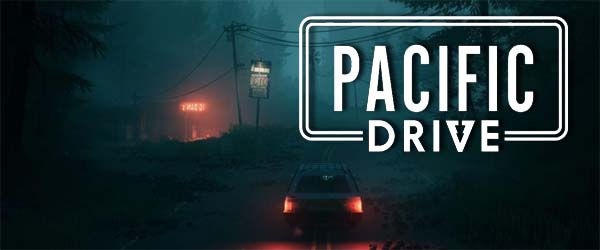
I really enjoyed Pacific Drive, but I admit that I struggled a bit in the early hours. The tutorial is decent, but it's a bit of an information overload, and the player doesn't really get much opportunity to practice certain mechanics so that they sink in.
So I wanted to share some of my tips based on the confusions and growing pains that I experienced, so that other new players can hopefully shorten the learning curve and get to enjoying the game more quickly.
[More]
When I first saw the trailers for Pacific Drive, it was being pitched as a survival horror that takes place entirely in a car. Or at least, that was my takeaway from the initial announcements and teasers. It had me intrigued, such that I immediately wishlisted the game. However, that isn't quite what the game ended up being. Instead, Pacific Drive is more of a survival/crafting/extraction game with light-to-moderate horror elements. There's also an emphasis on logging and cataloguing everything you encounter, which nullifies much of the horror and mystery that it could have, in favor of encouraging exploration and curiosity.
The bulk of the gameplay consists of driving to different parts of the map, scavenging for materials and supplies, and using those materials to craft upgrades for your possessed station wagon. And all the while, you're scanning almost everything you encounter in order to catalogue it (from paranormal phenomena, to resources and equipment, to the different types of wrecked vehicles you find rusting along the roadside, and everything in between). Maybe I misunderstood those initial announcements and teasers. Whether I misunderstood, or the game's concept was poorly communicated, or its design simply shifted over the course of the intervening year or so (which happens), the final game errs much closer to No Man's Sky than to Resident Evil, and might even have tiny hints of inspiration from things like Outer Wilds and Portal.
The crafting focus also means that the gameplay is split almost evenly between driving and scavenging on foot. I'm constantly getting out of the car to search an abandoned building for materials, or using the various tools to break down other wrecked vehicles for their constituent parts. So the idea that the game would be played entirely from within the car also ended up not being the case. In fact, a majority of my opening hours of the game were played on foot, since so much of the early game is a series of tutorials on how to craft various tools and car parts.
Pacific Drive can be serene and beautiful, and almost zen-like.
So Pacific Drive takes a while to really get going. Whether it's the sub-genre-defining horror game that I anticipated, or a more trendy survival/crafting/extraction game with a driving gimmick, Pacific Drive still turned out to be quite good and addicting. In fact, the survival and extraction focus might even have made it a better game than what I was envisioning in my own mind.
Grab 'n' Go
Pacific Drive's core gameplay loop is more akin to an extraction shooter, except that it's single-player PvE (Player vs Environment), and the player uses a possessed, beat-up old station wagon as your primary method of locomotion and eventual escape. You choose an area from a map menu, and the specific details of the area are pseudo-randomized each time you enter (and can change if you return later). You drive around the area, collecting any resources or materials you find, avoiding paranormal hazards, and occasionally finding documents or audio logs that slowly explain what happened to the Olympic Peninsula Exclusion Zone.
But there's also a ticking clock, and this is where the "extraction shooter" influence appears. If you lollygag too long, meticulously avoiding obstacles, and gingerly collecting everything that isn't nailed down, a blaring siren will sound, and a mysterious Fortnite-esque "storm" will slowly engulf the area. If you get caught in the storm, you'll slowly take damage until you either escape or die. And the only way to escape is usually to trigger a warp portal that appears somewhere on the map. These portals can only be activated if you're more than a certain distance away, and once activated, the storm starts to rapidly expand. You have only minutes to drive halfway across the map to the portal and escape, with the storm breathing down your neck.
Each voyage is punctuated by a frantic race to a gateway portal.
[More]
7a4a2b03-cfb0-42a5-88af-2605cfaebb55|6|3.7
Tags:Pacific Drive, Ironwood Studios, Kepler Interactive, car, driving, crafting, survival, horror, extraction, Pacific Northwest, ARDA, science, anomaly, garage, road, forest
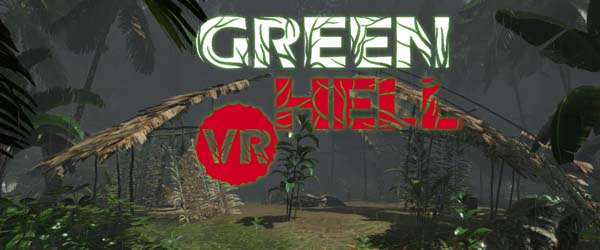
I always have mixed / complicated feelings about survival games. They always seem like a great idea in principle, and I feel like I would really enjoy them for their methodical gameplay oriented around problem-solving (which is one of the reasons I also love classic survival horror games). But when I actually play them, they are often annoying and frustrating, and I have a miserable time trying to learn how the game works.
I think a big part of the problem is that a lot of these games, being modest indie titles, don't have robust tutorials and aren't very good at communicating their gameplay mechanics to the player in an efficient manner. Even when they have tutorials, those tutorials feel like they barely scratch the surface of what the player needs to know. And then you're shoved out into the deep end, having to learn the rules of the game world and the controls for navigating it, while your precious food, water, and energy meters are all depleting. These games are insanely difficult in the early sessions because every new threat or challenge feels like an unfair "gotcha!" from the developers. Once I learn the systems (through lots of frustrating trial-and-error), I find that everything I need is readily available, and most of the fun and challenge of the game gets optimized away, leaving only the tedious chores.
Case in point, figuring out how to save the game in my first couple play sessions with Green Hell VR was a very aggravating experience. I don't recall the game ever telling me that saving requires building certain types of shelters. I assumed the game would autosave every time I slept, and possibly also every in-game day, or every 20 or 30 real-world minutes. So imagine my surprise when I slept, closed the game, and booted it up the next day to find that none of my progress from the previous session had been saved. No, sleeping in just any bed isn't enough to save the game in Green Hell. You need to craft one of 2 or 3 specific shelters, or at a specific landmark.
Saving the game can only be done at dedicated checkpoints, or at a crafted shelter.
Initially, crafting these shelters feels like a relatively daunting task. You need large sticks and palm leaves, both of which are too large and bulky to be stored in your backpack. Scavenging around for them can be time-consuming. They always seem to be everywhere as I'm walking through the jungle, but then nowhere to be found when I try to set up camp. It took me a while to figure out that I could get large sticks by cutting down certain trees, and that palm leaves could be easily cut off of palm trees. I was initially hesitant to use my sharp stones or basic axe to try cutting down these trees because the durability of these tools is so low. So I would wander around looking for loose logs and palm fronds to carry back to camp, all while my health and energy are slowly draining. Logs and leaves were the bane of my existence in the first few play sessions!
I don't have a problem with limiting the ability to save, nor do I have a problem with tying the save functionality to a resource. I've praised Resident Evil for doing those very same things. But Resident Evil at least very clearly explains how saving works, and gives the player an opportunity to save your progress right at the start of the game. The typewriter and an Ink Ribbon are right there in the first room of the game. Green Hell, on the other hand, requires playing through to a particular milestone before you find the first save point, which (depending on how you play) might be hours into the game.
[More]
6f7c7474-ac4b-410e-a7cc-4f2d0c7888d5|0|.0
Tags:Green Hell, Green Hell VR, VR, PSVR2, survival, jungle, Meta Quest 2, protein, carbs, fat, water, fire, animals, mushroom, hunt, crafting, amnesia, medicine, vaccine, anti-vaxxer
When I booted up my PS5 for the first time and signed into the PSN, I immediately downloaded a few of the must-have games. You know, the Demon's Souls remake, Miles Morales, and Returnal. I also downloaded some other ... shall we say "less high profile" games that piqued my interest, including the [ultimately very impressive] World War II shooter Hell Let Loose and a little indie game that claimed to be a sequel to H.G. Wells' classic sci-fi novel The War of the World, called Darker Skies.
Darker Skies takes place during the aftermath of H.G. Wells' classic novel The War of the Worlds,
but the visual and sound design is clearly pulled from the 2004 Steven Spielberg movie starring Tom Cruise.
Budget "Last of Us"
I didn't have high hopes for this budget indie title, but I was curious what a game developer would even do with a property like War of the Worlds. As soon as I saw the first enemy, a zombie shambling around just like a Clicker from The Last of Us, my heart sank. With all the potential of the source material, Steel Arts had to go with a zombie game?! The War of the Worlds is a classic sci-fi novel about a Martian invasion of Earth. My expectation for a video game adaptation of The War of the Worlds would either be some kind of survival horror game about surviving against Martians who survived exposure to Earth's microbes, or an action shooter about humans counter-attacking the Martians on Mars, or something akin to XCOM. It absolutely would not be a total knock off of The Last of Us, right down to having infected zombie humans.
And when I say this is a knock off of The Last of Us, I'm not just talking about the presence of Clicker-like zombies. The protagonist has an X-Ray "focus" vision, he scavenges random supplies in order to craft consumables supplies, and most encounters with enemies are intended to be dealt with by various throwable tools. There's even areas of the map that are overgrown with red Martian tendrils, similar to the spore-infested areas of The Last of Us, except this time around, the character doesn't need a gas mask to get through.
The character can use X-ray vision to detect enemies through walls, but only if they are moving.
The only thing missing is the tag-along NPC child character -- which is a big problem because the interactions between the two characters is a huge part of what makes The Last of Us a great game. That's where the heart and soul of that game was. If you played The Last of Us, and you thought the best thing to emulate is the crafting system, then I feel like maybe you missed the point...
[More]
72490b38-a75a-4bb0-8c2c-627a390787ae|1|2.0
Tags:Darker Skies, Steel Arts Software, indie gaming, PS5, H.G. Wells, The War of the Worlds, science fiction, horror, survival, crafting, zombies, The Last of Us

I've been diving into my Steam wishlist and backlog while waiting for this fall's suite of football video games. Stranded Deep is a game that I had on my Steam wishlist for years -- when it first became available through "early access" -- along with games like The Long Dark and The Forest. I don't typically invest in early access games because I don't want the incompleteness of the game to combine with my overly-critical eye and completely sour me to an experience that would likely be positive when the game is finished. This is also the reason that I rarely go back to games that received major overhauls post-release, like No Man's Sky or SimCity (2013) -- I'm already soured on the game, and it's unlikely to win me back.
I never got around to buying Stranded Deep on Steam, even after it left early access which is apparently still in early access on Steam, because the "survival sim" fad had petered out and my own interest in that particular game fizzled out as well.
Survival sims were a huge fad on Steam, but the fad started to fizzle out
long before indie titles like Stranded Deep or The Forest ever saw full releases.
But Stranded Deep showed up as another free game for PSPlus subscribers (along with Control), and I went ahead and downloaded it. Gotta get that $60 per year of value from the subscription somehow. Honestly, I use my PSPlus subscription mostly for the cloud storage. I consider it "game progress insurance" in case my console fails on me. So I rarely play the free games. But I mostly liked Control, so went ahead and gave Stranded Deep a shot too.
Stranded Deep is definitely not as good as Control.
Survival of the wiki-est
I kinda knew I was in for a disappointing experience when I had to pause the game during the tutorial in order to look up how to proceed. My girlfriend also said as much and wondered out loud why I would even continue playing a game that couldn't even do an adequate job of communicating its fundamental mechanics. She said I have much more patience than her, because she would have given up right then and there.
I had troubles right from the start with simple things like operating the inventory and performing some of the early tutorial crafting. The thing that dead-ended my progress and forced me to look online was trying to figure out where to get the leaves to make rope to craft the knife. I thought I would use leaves from trees, but I wasn't sure which trees, nor was I sure how to pull leaves from trees. The game lets me pluck coconuts off of trees, so I thought it would allow the same for plucking leaves off of trees. Nope. So I tried using my stone tool to cut leaves off of palm trees, only to get palm fronds, which cannot be made into rope. Then I started doing laps around the island looking for seaweed or hemp or something. So 2 minutes into the game, and there I was stuck on the tutorial.
I had to go online to find where to get fibrous leaves.
It turns out, the necessary fibrous leaves are harvested from the exactly 2 yucca plants on my starting island, both of which are kind of hidden next to large boulders. Or I could cut the baby palms growing all over the island for small amounts of fibrous leaves. But I didn't think to try this because I didn't have any reason to think that the baby palm fronds would be any different from the adult palm fronds.
This specific tutorial problem could have been fixed by modifying the tutorial objectives to specifically tell the player to harvest fibrous leaves from a yucca or baby palm. More generally though, it would have been helpful if the game could provide a tooltip when the player hovers over certain resources that explains what that resource might be used for. Or have the character speak to himself out loud that "I could probably use the leaves of that yucca to make rope.". The character comments out loud how "disgusting" it is to skin an animal every time I do it (even though the character has been living off of skinned animals for weeks and should be used to it), so the developers were definitely able to implement contextual dialogue. And even if that kind of dialogue is too difficult to implement, an "examine" button (like in old-school survival horror games) could have worked to tell the player in plain text what can be done with any given resource on the island. [More]
|

| 12 | | | | | | | 60 | | 11 | | | | | | | 55 | | 10 | | | | | | | 50 | | 09 | | | | | | | 45 | | 08 | | | | | | | 40 | | 07 | | | | | | | 35 | | 06 | | | | | | | 30 | | 05 | | | | | | | 25 | | 04 | | | | | | | 20 | | 03 | | | | | | | 15 | | 02 | | | | | | | 10 | | 01 | | | | | | | 05 |
|