
I'm going to change pace a little bit for this installment of "How Madden Fails To Simulate Football". Previously, I've focused on the rules of the game and on on-field gameplay. This time, I'm going to go off the field and start talking about team-building and coaching strategies, which are key to creating an engaging Franchise Mode experience.

This is a topic that was voted upon by my Patrons. If you would like to have voting power to influence the content that I create, then I encourage you to support my content creation through Patreon. Patron support helps offsets the cost of the server for my blog, the license for the software that I use to YouTube edit videos, and any research material that I buy.
The COVID years have been hard on a lot of people, and many of my Patrons had to discontinue their support due to financial hardships. I want to take a moment to wish all my former Patrons the best. I hope that 2022 treated you better, and that 2023 will be better yet. I'd also like to thank my current Patrons and those who stuck with me. To all my Patrons -- past, present, and future -- thank you for your support.
Now let's talk football! I'm writing drafted this essay in the month or 2 leading up to the 2023 NFL Draft, so this topic will actually be kind of relevant at the time that it is published.
The full video on YouTube contains additional commentary and examples.
One of the ways that Madden is most different from real life football is that in Madden, the exact skill level of every player in the league is known to everyone all the time. Because of the way that Madden implements player attributes and progression, users don't have to evaluate player talent at all. Ever. In the vast majority of cases, ordering your depth chart is a simple matter of sorting the players by their overall ratings. And if it's not the overall rating, then there's usually a single other attribute rating that determines who starts and who doesn't. It's usually speed. For example, I favor kick and punt returners with speed, and usually put my fastest reserve player as my starting returner, regardless of his overall rating. So yes, there are some edge cases where a user gets to make judgement calls about which player better fits your play style. But for the most part, it's all about that overall rating.
This means that there is no mystery or question about which players are actually good, which players aren't so good, and which players are outright busts. It also means that Madden doesn't have true position battles. One player is objectively better than the other in the vast, overwhelming majority of cases, even if it is just marginally so. It means there's no question whether a free agent or trade will be an upgrade over the players already on your roster. It means that there isn't much value in testing out rookies in the preseason because you already know exactly how good those players are, and whether they are deserving of a starting position or roster spot based on their overall rating.
All of the intrigue and "what ifs" that go into roster movements and decisions in NFL front offices are simply non-existent in Madden because so much of the game is based on these absolute numbers that are completely open and transparent to everybody.
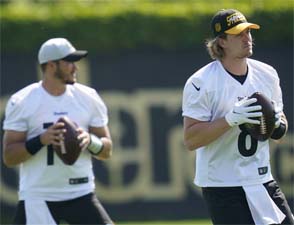 photo credit: Pittsburgh Post Gazette
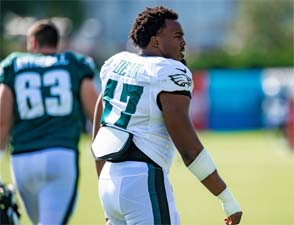 photo credit: John Jones / Icon Sportswire
Every year, there are questions about who is the best player in many teams' lineups.
Think of some of the big questions from early in the 2022 season: Is Mitch Trubisky better than the rookie Kenny Pickett? Should Devin Singletary get more carries than James Cook? How about Tony Pollard or Ezekiel Elliot? Should the Packers look to Allen Lazard or Sammy Watkins to replace the lost productivity of Devante Adams? Will Nakobe Dean play well enough as a rookie linebacker for the Eagles, or should they stick with their veteran starter from last year? Is Bailey Zappe better than Mac Jones? Is Trey Lance better than Jimmy Garoppolo?
[More]
9f10d671-d80e-4d7a-9525-a0be037a7e58|19|2.8
Tags:Madden, Madden NFL, How Madden Fails to Simulate Football, EA, EA Sports, Electronic Arts, Tiburon, football, simulation, sports, YouTube, preseason, training camp, draft
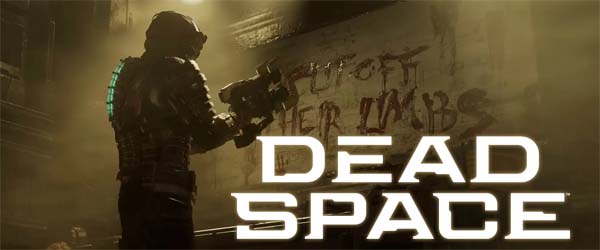
I'm gonna be perfectly honest with you right up front: I'm coming into this review with a negative bias. This is a remake that does not need to exist. Dead Space is only 10 years old, is an HD game that still looks fine. It is designed around gameplay conventions that are still standard practice today, and so the original still holds up well, outside of some mildly-dated presentation. I get the desire to remake or re-imagine older games that actually are dated, like Resident Evil 2 or Final Fantasy VII, which were both completely redesigned with modern gameplay conventions and (in especially in the case of Final Fantasy VII) bold new creative and narrative decisions. I would also understand the desire to go back and take another stab at more recent games which are really good, but which may have been virtually unplayable due to technical problems. Fallout: New Vegas comes to mind.
But this recent fad of rote remasts or remakes of PS3-era games that were already highly-polished and still modern-feeling (and thus hold up well today) just feels like lazy, cynical cash-grabs to me. Games like Dead Space, The Last of Us, and Mass Effect just feel like completely unnecessary remakes -- especially if they're going to be direct recreations of the original with little-to-no creative liberty. Heck, even the Demon's Souls remake feels unnecessary. I would much rather than Sony and FromSoft just release a digital version of the PS3 game on the PS4 and PS5 storefronts and keep the servers going. Maybe even patch the PS3 game with some of the ease-of-use features that were added for the PS5 remake. I'm still on the fence about Silent Hill 2 and Resident Evil 4, since those remakes might take enough creative liberty to justify their existence (assuming they don't shit the bed in doing so). As such, I did not buy this remake of Dead Space retail. I bought a used, second-hand copy in order to save a few bucks and to not give money to EA (and so as not to seem to give implicit support for this trend of unnecessary remakes).
Coming off of Callisto Protocol, Dead Space feels like a masterpiece.
All that being said, having just recently come off of playing through The Callisto Protocol, the difference is night-and-day. This Dead Space remake is, by far, the much better game. It's a good remake of a good game, and it's a good survival horror game in its own right.
Mostly how I remember it
Dead Space is a pretty straight-forward, by-the-numbers recreation of the original game, with only a few creative liberties taken. It's still a 3rd person shooter built around the challenge of shooting off the limbs of zombies and monsters instead of aiming for the center of mass or going for head shots. The story, mission structure, map, and many set pieces will all be completely recognizable to anyone who played the original game, even though some things here and there might be a little different.
As such, pretty much any review of the original Dead Space still holds mostly true here. All the things that I liked about the original game are still present. Unfortunately, I never reviewed the first Dead Space on this blog, so I can't just link you to that. I'll have to just summarize my feelings here.
Isaac is fully voiced and has more agency compared to the original.
The enemies are threatening, and the combat is challenging. The non-traditional weapons, combined with kinesis and stasis and creative enemy design, provide a lot of variety and strategy in combat that goes far beyond just "shoot bad guy in the head". The setting and lighting really help to sell the sci-fi horror aesthetic. The in-universe, diegetic, holographic interface holds up well and never pulls the player out of the immersive environment. The Ishimura itself still feels like a believable, functional place. The story is derivative, cliché, and cringe-worthy in some parts, but I do like the religious undertones and parody of Scientology. [More]
fd3c4399-577e-4a0d-b05d-256753797daf|1|5.0
Tags:Dead Space, Electronic Arts, Motive, Visceral, remake, horror, survival horror, science fiction, shooter, zombie, necromorph, dismemberment, religion, Scientology, Unitology
Before I begin this essay, I would like to invite my readers to become supporters through Patreon and be able to vote in a poll to decide the next topic in this series. I have several broad outlines for topics, but no actual draft yet. So I'm asking my Patrons to decide which of those topics I should cover. The poll closes at the end of October, at which time, I expect to start work on the draft for the next topic.
I'd like to take this moment real quick to sincerely thank my current Patrons. Your support really helps, to by offsetting the maintenance of this site, and the cost of software licensing that I use to create content for this site and my YouTube channel.
I also want to provide a short disclaimer that the original video was posted before I had a chance to play any of Madden 23. I have since played several matches in Madden 23, and can confirm that none of the problems discussed in this video have been fixed or addressed. In fact, issues with fumbled footballs teleporting into the hands of the recovering player seem to have gotten worse in the newer game. In just a handful of matches, I've already seen multiple examples of the football teleporting through the bodies of prone players and into the hand of a recovering player who is a full yard or two away from the football. It's bad.
Anyway, onto the actual topic!
This essay is also available in video format on YouTube.
The previous topic was about Longsnapping, and included proposals for adding both ratings-based and skill-based botched snaps into the game. Botching a snap might lead to a bad kick, or a kick being blocked, or the snap sailing over the head of the holder or punter for a fumble. But even though I want botched snaps to be represented in the game, there is one caveat. One of the biggest and most long-standing A.I. and animation problems with Madden is its lose-ball scenarios, and putting bad snaps into the game might not be a good idea unless Tiburon and EA also address this long-standing problem.
But hey, Madden already has muffed punt returns, onside kicks, strip sacks, and just regular old fumbles in the game already, so once again I ask: why are all these other things in the game, but botched snaps are a bridge too far?
Anyway, some of the issues with the pass rush that I mentioned in the Pass Rush essay would also be alleviated by better loose-ball logic. The excessive strip sacks of Madden 17 and Madden 21 might not have been such a big problem if the players were smarter about recovering their own fumbles, and if scooping and scoring weren't so easy for defenders. But I'm getting ahead of myself. Let's now look at how Madden fails to model fumbles, fumble recoveries, onside kicks, and other loose-ball situations.
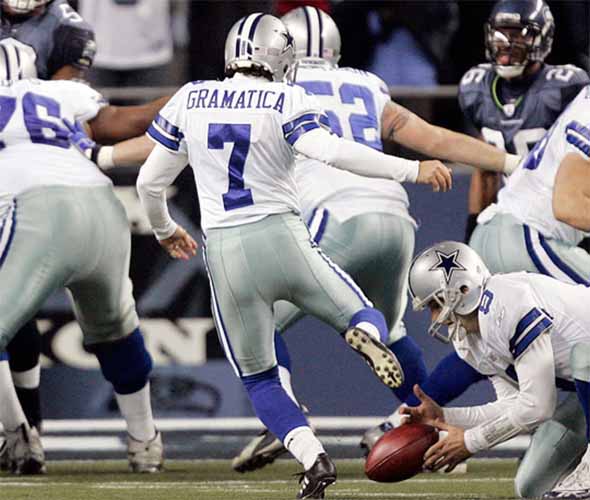 Photo credit: Sports Illustraded
Adding botched snaps to the game would exacerbate existing issues with fumbles and fumble recoveries.
[More]
45330120-4b66-4583-be01-f6a356253cc1|0|.0
Tags:Madden, Madden NFL, Madden NFL 21, Madden NFL 22, EA, EA Sports, Electronic Arts, Tiburon, football, simulation, sports, fumble, fight for the fumble, onside kick, All Pro Football 2k8
For the past few years, Madden Franchise gamers have been reporting a glitch in which the game will softlock and hang on the loading screen after exiting a Franchise match. If this happens, the only way to resume the game is to force quit the Madden app, re-launch, and attempt to resume the Franchise. If this happens after the score goes final, then all progress will be lost, and the user will have to re-play that match from the beginning. For some users, this softlock occurs every time they finish a Franchise match, which renders Franchise Mode completely un-playable. This softlock glitch goes back to at least Madden 21, and might go back further, and it seems to happen to both online and off-line Franchise players.
I am going to explain the glitch itself, so that everybody knows what, specific softlock I'm talking about. Then I'll go over my proposed work-around. Then I'll discuss why I think the softlock happens, how it can potentially be fixed, and the specific game conditions that lead to me experiencing this softlock.
UPDATE 18 January, 2022:
Apparently, EA thinks they've finally fixed this bug in the most recent update. It only took 2 releases for them to finally do it. Oddly, I didn't see this patch announcement until after publishing this work-around, even though I had searched for it. Yet, oddly enough, I encountered the bug this past weekend, after the patch was supposedly released. So it's possible this bug is still in the game, and EA didn't catch all the causes. So if you encounter this bug in your games, try the work-around described below. Hopefully it works.
What happens, and how to work-around it
Usually, Franchise matches autosave after every play. If the game freezes, or the connection to the server is lost during an online Franchise match, Franchise games can usually be resumed from the last play that finished before exiting the Franchise match. If you get booted, or the game freezes, it usually only requires replaying one play, maybe.
But if the softlock happens while loading the Franchise Hub after finishing the match, you're screwed. This is because the in-game autosave is apparently deleted after the score goes final, but the Franchise file is not saved until the user returns to the Franchise Hub. So if a crash or freeze happens between these points, the whole match's progress is lost. This is bad programming from EA Sports and Tiburon -- no "ifs", "ands", or "buts" about it.
There is usually an auto-save after each play in Franchise matches.
I've been experiencing this problem on both PS4 and PS5 versions of Madden 22, and after a bit of experimentation, I think I may have found a work-around -- at least for online Franchise players. This work-around is based on my suspicion of why the softlock is happening, and takes advantage of teh in-game auto-save to try to prevent the softlock from happening.
The work-around is to try to exit the match prior to the score going final, and then resume from the autosave. For example, just before the last play of the game, pause and exit to the menu. Even if the game softlocks on the loading screen, you can force-quit, re-launch Madden, and resume the Franchise match from the auto-save. If you do this, you should hopefully be able to execute the final play, finish the game, and hopefully Madden will properly load the Franchise Hub. Just do not let the score go final before closing and re-loading!
If you are playing offline, you must force-close the game. Do not simply pause and quit, as doing so will delete in-match auto-save and return you to the Franchise Hub. If you force-close, then you'll be able to resume from the auto-save next time to try to load your offline Franchise.
Quitting and re-loading the autosave before the last play of the game may
preserve progress and bypass the softlock. [More]
4bf50216-43d5-4920-8d40-60614f1984e2|0|.0
Tags:Madden NFL, Madden NFL 21, Madden NFL 22, Electronic Arts, EA Sports, Tiburon, glitch, softlock, loading screen, franchise, memory leak
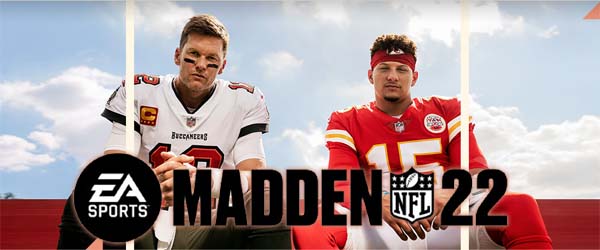
I knew it was a bad sign when the "tutorial" demo game for Madden 22 did not explain or tutorialize any new gameplay features at all. The reason is probably because there aren't any new gameplay features in Madden 22 -- at least not for the current-gen systems. If you want the advertised "home-field advantage" and momentum features, you need a PS5 or XBox Series X|S. Apparently, EA said this would be the case, but since I didn't pay too much attention to pre-release news, I wasn't aware of this fact when I bought my used copy of Madden 22 off of eBay a couple weeks after the game released. I remember reading that the "momentum" feature would not be in last-gen versions, but I thought that was a different feature from the Home-Field Advantage. I guess not. I still don't have a new console, so I'm stuck playing the inferior last-gen game.
I honestly don't see any technical reason why home-field advantage and momentum couldn't be included in the last-gen versions. It doesn't seem like it would be a technically demanding thing to include. I would be willing to bet that, since people complained about last year's next-gen game being identical to the last-gen versions, EA decided to just withhold features from last-gen this year in order to make the next-gen look like a legit improvement.
The heavily-promoted Home-Field Advantage feature was withheld from the last-gen versions,
even though I see no technical reason for why it couldn't have been included.
What EA failed to realize is that the complaint wasn't really that the next-gen games wasn't different from last-gen; the complaint was that EA wasn't doing anything with the hardware that they couldn't do in last-gen. Simply withholding features from last-gen that are perfectly possible to include from a technical standpoint does nothing to address the fundamental complaint that the next-gen game does not feel "next-gen" in any substantive way.
Personally, I actually thought that last year's next-gen version did have noticeably better player movement and overall game pacing in the one match that I was able to play on a friend's PS5. The higher framerate and more precise movement gave me a much greater sense of control. The improvement was most noticeable on inside running plays, in which I found it much easier to squeeze into the gaps for positive yards, instead of just ramming into the asses of my blockers, or right into backside pursuit. The problem was that the animation system and A.I. looked identical to last-gen, even if some of the physics and locomotion were better.
Frustratingly, many users seemed to complain about last year's next-gen version feeling "too slow", so I wouldn't be surprised if all of those subtle improvements were stripped out from this year's next-gen version. I guess I'll find out if / when I get a chance to play this year's next-gen version. If I do get to play the next-gen version, and notice that it does feel substantively different in any way, I'll be sure to update this review, or post an additional review of the next-gen version. So be sure to check back for that...
#FixMaddenFranchise movement finally forced token upgrades
Thankfully, the new Franchise features at least made it into the last-gen version; otherwise, there would be absolutely nothing new in the game at all. EA finally did make additions to Franchise, but the effort feels limp, and it came at the cost of removing some of my favorite features from this past generation of Madden Franchise modes.
Axis Football has been offering full coaching staffs (including position coaches) for years now.
Adding offensive and defensive coordinators has long been considered to be the bare minimum that EA could (and should) do to improve Madden's Franchise mode. We only get a head coach, offensive coordinator, a defensive coordinator, and some abstract "personnel" manager. If you were expecting a full slate of position coaches, as has been offered in Axis Football for the past few years, then you'll be disappointed. There's not even a special teams coordinator. Let alone a team doctor / medical staff or talent scouts (at least not when the game released). [More]
c0200815-bbbf-4de6-a189-dbaedc2a84f6|0|.0
Tags:Madden NFL, Madden NFL 22, Electronic Arts, EA Sports, Tiburon, sports, football, simulation, franchise, coach, skill tree, draft, scouting, game prep, home field advantage, Axis Football, NCAA Football
|

| 12 | | | | | | | 60 | | 11 | | | | | | | 55 | | 10 | | | | | | | 50 | | 09 | | | | | | | 45 | | 08 | | | | | | | 40 | | 07 | | | | | | | 35 | | 06 | | | | | | | 30 | | 05 | | | | | | | 25 | | 04 | | | | | | | 20 | | 03 | | | | | | | 15 | | 02 | | | | | | | 10 | | 01 | | | | | | | 05 |
|