
I'm going to change pace a little bit for this installment of "How Madden Fails To Simulate Football". Previously, I've focused on the rules of the game and on on-field gameplay. This time, I'm going to go off the field and start talking about team-building and coaching strategies, which are key to creating an engaging Franchise Mode experience.

This is a topic that was voted upon by my Patrons. If you would like to have voting power to influence the content that I create, then I encourage you to support my content creation through Patreon. Patron support helps offsets the cost of the server for my blog, the license for the software that I use to YouTube edit videos, and any research material that I buy.
The COVID years have been hard on a lot of people, and many of my Patrons had to discontinue their support due to financial hardships. I want to take a moment to wish all my former Patrons the best. I hope that 2022 treated you better, and that 2023 will be better yet. I'd also like to thank my current Patrons and those who stuck with me. To all my Patrons -- past, present, and future -- thank you for your support.
Now let's talk football! I'm writing drafted this essay in the month or 2 leading up to the 2023 NFL Draft, so this topic will actually be kind of relevant at the time that it is published.
The full video on YouTube contains additional commentary and examples.
One of the ways that Madden is most different from real life football is that in Madden, the exact skill level of every player in the league is known to everyone all the time. Because of the way that Madden implements player attributes and progression, users don't have to evaluate player talent at all. Ever. In the vast majority of cases, ordering your depth chart is a simple matter of sorting the players by their overall ratings. And if it's not the overall rating, then there's usually a single other attribute rating that determines who starts and who doesn't. It's usually speed. For example, I favor kick and punt returners with speed, and usually put my fastest reserve player as my starting returner, regardless of his overall rating. So yes, there are some edge cases where a user gets to make judgement calls about which player better fits your play style. But for the most part, it's all about that overall rating.
This means that there is no mystery or question about which players are actually good, which players aren't so good, and which players are outright busts. It also means that Madden doesn't have true position battles. One player is objectively better than the other in the vast, overwhelming majority of cases, even if it is just marginally so. It means there's no question whether a free agent or trade will be an upgrade over the players already on your roster. It means that there isn't much value in testing out rookies in the preseason because you already know exactly how good those players are, and whether they are deserving of a starting position or roster spot based on their overall rating.
All of the intrigue and "what ifs" that go into roster movements and decisions in NFL front offices are simply non-existent in Madden because so much of the game is based on these absolute numbers that are completely open and transparent to everybody.
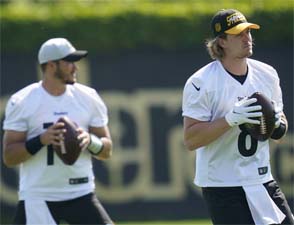 photo credit: Pittsburgh Post Gazette
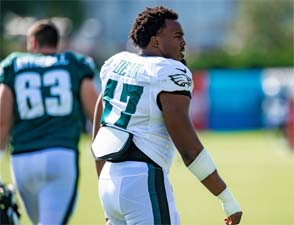 photo credit: John Jones / Icon Sportswire
Every year, there are questions about who is the best player in many teams' lineups.
Think of some of the big questions from early in the 2022 season: Is Mitch Trubisky better than the rookie Kenny Pickett? Should Devin Singletary get more carries than James Cook? How about Tony Pollard or Ezekiel Elliot? Should the Packers look to Allen Lazard or Sammy Watkins to replace the lost productivity of Devante Adams? Will Nakobe Dean play well enough as a rookie linebacker for the Eagles, or should they stick with their veteran starter from last year? Is Bailey Zappe better than Mac Jones? Is Trey Lance better than Jimmy Garoppolo?
[More]
9f10d671-d80e-4d7a-9525-a0be037a7e58|19|2.8
Tags:Madden, Madden NFL, How Madden Fails to Simulate Football, EA, EA Sports, Electronic Arts, Tiburon, football, simulation, sports, YouTube, preseason, training camp, draft
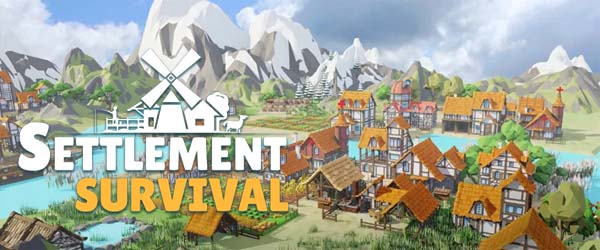
As my frequent readers probably know, I am a sucker for city-building and village-building games. I buy a few new ones almost every year, and ever since the release of Banished, the medieval village sim has been all the rage. Though it looks like post-apocalyptic settlement builders are also becoming a hot sub-genre -- probably as a result of the popularity of the settlement-building in Fallout 4. Anyway, last year, Chichian encouraged me to try out a then-Early Access title called Settlement Survival. I was hooked on it for a couple months, and then set it aside with the intent to come back to it later. In the meantime, the game saw its official Steam retail release, which encouraged me to go back and give it a second go (and formal review).
Time to plan
Settlement Survival is one of the more addictive and challenging city-builders that I've played. It features a complicated web of production chains and resources, which can be a real challenge to plan and manage. Trying to unlock and use everything in a single village will take a lot of time, effort, and planning.
Settlement Survival provides a handy-dandy timeline in the top right corner of the screen which shows when all the seasons start and end, and which also shows icons for important upcoming events. Everything from the arrival of a merchant ship, to incoming immigrants, and even disasters or other random events will be forecast a whole year in advance. This gives the player plenty of time to plan ahead, and avoids the problem of the player feeling un-prepared to take advantage of an un-expected boon or to mitigate a disaster.
This timeline is the core gimmick of the game, as it enables long-term planning.
There are also random events that are not forecast on the timeline, and they often require that the player have certain resources or tools on-hand. But these are rarely destructive, so worst case is that you miss out on the opportunity to get some free bonus resources (which you may or may not have needed anyway). Nevertheless, it does put a pressure on the player to build up a surplus stockpile of many goods in case one of these events pops up. Tools and beer being the most common items used for such events, based on my experience.
This timeline helps to create some medium and long-term planning and reward structures that really makes the game crazy addictive. There's the short-term goals for things like building the next building. Then there's the medium-term goals like completing the next harvest season. And then there's the longer-term goals like accumulating goods to trade to an incoming merchant ship, or waiting for the next batch of immigrants to give you a labor surplus that can allow you to go on the next wave of building infrastructure. There's always some milestone right over the horizon, and then another right beyond that, and I find myself playing longer than I had planned, and long after I should have gone to bed, because I want to get to that next harvest, or trade opportunity, or make sure that I get through that next disaster.
This also means that random disasters don't feel as annoying because you have plenty of warning that a disaster is coming, and can prepare accordingly. Further, the disasters themselves rarely kill population directly. Rather, they usually impact your resource-generation for a period of time. So most disasters are mitigated simply by stockpiling the affected resource ahead of time.
There are also random events that do not appear on the timeline.
The timeline also discourages save-scumming. Disasters are forecast a whole in-game year ahead of time, so re-loading to before the disaster would require going back more than a whole year. And that might not even necessarily save you, since I've noticed that the disasters still happen at the same time, even if I go back to a save from before the disaster shows up in the timeline. I'm not sure how long in advance they are generated, but the fact that I know that I can't avoid it by simply reloading and re-rolling a die means that I'm more inclined to batten down the hatches and just roll with whatever happens.
The end result is that the gameplay ends up feeling more organic, and the challenge of surviving and growing your fledgling settlement remains relatively high. When I do save-scum, it's usually to undo some mistake that I made, so that I learn from my mistake, fix it and do better; rather than to outright cheat by undoing some random event that the game threw at me.
[More]
I wrote previously about my trepidations regarding the free-to-play status of Modus Games' reboot of Maximum Football. I'm not going to retread that again here. Instead, I've poured over the announcement trailer, dev diaries, and other information about the game, and would like to discuss my impressions on how the game might play, based on the publicly-available information and video.
The announcement trailer shows a few clips of gameplay, but doesn't provide a whole lot more information.
There have so far been 2 development updates, in addition to the announcement trailer. All these videos show a little bit of gameplay, but not much. So I don't have a whole lot to go on. But I'm going to go through each video and try to identify gameplay issues that stand out to me.
Rebuilt gameplay
The first develop update, released last June, was focused on the gameplay goals of the development team. They say they want to focus on authentic, simulation gameplay. They threw away all the assets and animations from the original Maximum Football codebase (developed by Canuck Play) in order to rebuild everything from the ground up. This includes bringing in professional and college athletes for motion capture and shifting to the Unreal Engine (I think Canuck was using Unity?).
Dev Update 1 (June 2022) covers the main goals of gameplay.
The visuals certainly look a lot better than what Canuck Play was able to create. Player models and stadiums look a lot more detailed and realistic. The jury is still kind of our on whether the animation and control will be dramatically improved, because it's hard to get a feel for the animation and controls from a simple video. [More]
96ba4a28-0f77-47a9-9b96-992161e2efce|1|5.0
Tags:Maximum Football, Modus Games. Micah Brown, football, simulation, free-to-play, blocking, customization, college, dynasty, franchise, recruiting, scouting, coach
Yesterday, Modus Games released its first actual announcement trailer for its upcoming revival of the Maximum Football series. The trailer was mostly heavily-edited, short clips of action from replays, but there was some gameplay mixed in as well. This gives us an actual indication of how the new football sim might play. The other 2 important tidbits from the trailer are the game's release window, and its price. No specific release date was given, except for a "fall 2023" window. Hopefully it is early fall: August or early September. We don't want the game showing up in the middle of October, when the NFL season is already half over, and the excitement for the new season has already died down a bit.
Modus Games has released the announcement trailer for Maximum Football, due out this fall.
The most interesting piece of information, however, is the game's price. The trailer revealed that Maximum Football will be a "free-to-play" game. Maximum Football's director, Micah Brown, has stated that being free-to-play allows Modus "to build on the game over time, alongside the community." Presumably, this means that there will not be a new, annual release of Maximum Football either. It will likely be a single game that will be updated with new features over the years. Similar to how a game like Fortnite has its different "seasons". According to Micah Brown:
"We want to create a football platform where users can play with tons of different rule sets, field configurations, severe weather changes and more without having to relaunch the game every year. Users shouldn’t have to rebuild their franchises from scratch every year when they purchase a new sports title."
The free-to-play model also means that we won't necessarily have to restart out career campaigns from scratch every year when a new game launches. We can presumably keep playing the same Franchise or Dynasty and develop the same team for years. That sounds awesome! I've been asking Axis Football's devs to implement save file transfers from year to year as well, as it's a great idea for a non-licensed game.
Being able to carry a Franchise save from one game release to another is one item on my Axis Football wishlist.
On the one hand, this is all good news. Free is good. This ensures that anybody who wants to play the game will be able to. No concerns about "wasting money" on a potentially lackluster product.
But on the other hand, Modus has to include some monetization scheme. They have to make money. They have to pay their developers for ongoing maintenance and development. They have to maintain servers for online play. And so forth. This has me a bit concerned, considering the game is un-licensed and will emphasize customization. How much of that customization will the users have to pay for? Again, from Micah Brown:
"In addition to the robust customization options that exist for players, we will be offering a selection of premium goods and licensed equipment that can be purchased to further expand the customization options."
[More]
Before I begin this essay, I would like to invite my readers to become supporters through Patreon and be able to vote in a poll to decide the next topic in this series. I have several broad outlines for topics, but no actual draft yet. So I'm asking my Patrons to decide which of those topics I should cover. The poll closes at the end of October, at which time, I expect to start work on the draft for the next topic.
I'd like to take this moment real quick to sincerely thank my current Patrons. Your support really helps, to by offsetting the maintenance of this site, and the cost of software licensing that I use to create content for this site and my YouTube channel.
I also want to provide a short disclaimer that the original video was posted before I had a chance to play any of Madden 23. I have since played several matches in Madden 23, and can confirm that none of the problems discussed in this video have been fixed or addressed. In fact, issues with fumbled footballs teleporting into the hands of the recovering player seem to have gotten worse in the newer game. In just a handful of matches, I've already seen multiple examples of the football teleporting through the bodies of prone players and into the hand of a recovering player who is a full yard or two away from the football. It's bad.
Anyway, onto the actual topic!
This essay is also available in video format on YouTube.
The previous topic was about Longsnapping, and included proposals for adding both ratings-based and skill-based botched snaps into the game. Botching a snap might lead to a bad kick, or a kick being blocked, or the snap sailing over the head of the holder or punter for a fumble. But even though I want botched snaps to be represented in the game, there is one caveat. One of the biggest and most long-standing A.I. and animation problems with Madden is its lose-ball scenarios, and putting bad snaps into the game might not be a good idea unless Tiburon and EA also address this long-standing problem.
But hey, Madden already has muffed punt returns, onside kicks, strip sacks, and just regular old fumbles in the game already, so once again I ask: why are all these other things in the game, but botched snaps are a bridge too far?
Anyway, some of the issues with the pass rush that I mentioned in the Pass Rush essay would also be alleviated by better loose-ball logic. The excessive strip sacks of Madden 17 and Madden 21 might not have been such a big problem if the players were smarter about recovering their own fumbles, and if scooping and scoring weren't so easy for defenders. But I'm getting ahead of myself. Let's now look at how Madden fails to model fumbles, fumble recoveries, onside kicks, and other loose-ball situations.
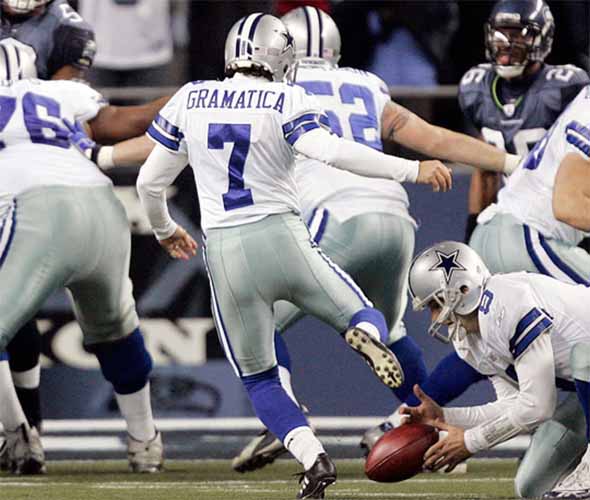 Photo credit: Sports Illustraded
Adding botched snaps to the game would exacerbate existing issues with fumbles and fumble recoveries.
[More]
45330120-4b66-4583-be01-f6a356253cc1|0|.0
Tags:Madden, Madden NFL, Madden NFL 21, Madden NFL 22, EA, EA Sports, Electronic Arts, Tiburon, football, simulation, sports, fumble, fight for the fumble, onside kick, All Pro Football 2k8
|

| 12 | | | | | | | 60 | | 11 | | | | | | | 55 | | 10 | | | | | | | 50 | | 09 | | | | | | | 45 | | 08 | | | | | | | 40 | | 07 | | | | | | | 35 | | 06 | | | | | | | 30 | | 05 | | | | | | | 25 | | 04 | | | | | | | 20 | | 03 | | | | | | | 15 | | 02 | | | | | | | 10 | | 01 | | | | | | | 05 |
|