Cities: Skylines: After Dark

It's been a very long time since I've had a city-building game that I really enjoy. So it was a real treat to find Cities: Skylines last year. It was the first game to really capture the magic of the classic SimCity games and make them work in full 3-D, and managed to achieve the goal of abstract population agency that the SimCity reboot failed so horribly at. But as much as I loved Skylines, I was also very aware of many of its limitations. It didn't have as much content as you might expect from a game coming from a larger publisher (like EA), and there were certain elements of its abstraction that felt a little shallow or weird. The game's first expansion, After Dark, tries to address these limitations, but it doesn't really succeed.

The free update is a nice gesture, but ...

First and foremost, I have to clarify exactly what the expansion encompasses, since Colossal Order has created a bit of confusion on this topic. They launched a free update for the base Cities: Skylines game in parallel with the release of the After Dark expansion. This update included some of the core feature upgrades that the expansion's content depended on. Most notably, a day/night cycle, new zoned buildings, and upgraded crime systems. If you have Cities: Skylines, then you get these features as a free patch, and have probably been playing with them for months.

Cities Skylines - day / night cycle
The day/night cycle is a free upgrade to the core game, but makes the core game feel somewhat incomplete.

While I applaud Colossal Order for the good will they foster by being willing to give away new functionality for free, this does kind of put players of the vanilla game in a strange situation. You get some of the new features, but not any of the ploppable buildings or city policy options that make them work. You get more crime, but not the prisons in which to lock up and rehabilitate criminals. You get the day/night cycle, but not the fancy new leisure and tourism zones that make nighttime mechanically relevant. In some ways, it takes the core game that felt very complete on its own, and suddenly makes it feel incomplete in subtle ways.

Fortunately, the menu gives you the option to turn the day/night cycle off, which helps to preserve the integrity of the original game. But then you don't get the new feature.

The update won't harm any of your existing save files though - with one major exception. If you made the unfortunate mistake of creating a city that was completely dependent on solar power, then the day/night cycle will screw that city over big time! In the core game, this was actually the most optimal way to go. Solar didn't pollute, wasn't dependent on depleting resources, and money was easy enough to make that the cost wasn't a big enough deterrent to using solar. But with the day/night update, once the sun goes down, all those fancy, expensive solar panels completely stop working! This can lead to your entire city going into a blackout as soon as you boot up your save file. Suddenly, not only is solar non-optimal, but it's practically useless since it doesn't work for half the game. And this isn't something that you can fix by just increasing solar power funding or building more plants; the power output drops to zero!

Cities Skylines - solar-induced nightly blackouts
Solar power plants stop working completely during the night, leading to massive blackouts.

Fun at night, and in the sun

I did complain somewhat about the lack of a day-night cycle in the base game, but the implementation that Colossal Order gave us is a bit uncomfortable and awkward. The rapid progress of a "day" in the game means that they couldn't transition from day to night in a single game-day, or else the game would just be constantly flickering between day and night. The developers apparently didn't want to slow down the game-day either, since that would probably upset many elements of the game's economic and agent systems. So instead, your cities get about a month-and-a-half of day, followed by about a month-and-a-half of night. Individual citizens seem to go about a daily cycle within this time. They aren't bound to it though. I've seen some citizens go back and forth between home and a near-by job several times during the day-time, then spend the whole night out at a restaurant or nightclub; and other citizens can spend the entire daytime commuting to and from work only to spend most of the night sitting in the office. They start their cycles at staggered times during the day; thus, sparing us from the annoying pathfinding and gridlock issues that plagued SimCity (2013). It all ... works ... at a very abstract level; it just feels weird...

[More]

Playing games like Skyrim, Grand Theft Auto, Assassin's Creed: Black Flag, The Witcher 3, Mad Max, Metal Gear Solid V, and other open-world games has made me increasingly weary of open-world gaming. Narrative-based, open world games like these suffer from a problem that I have started calling "open world limbo" (or "open world purgatory"). This is a sort of paradoxical offshoot of the concept of ludonarrative dissonance. The game's open world "sandbox" design seems to directly conflict with the narrative that the game is trying to tell. It specifically refers to the conflict between the story and the game's open world, rather than a conflict between the game's story and any particular game system(s). Generally, this manifests as the game designers setting the stakes so high that the player should feel pressured to progress the narrative, but the game's open world design never follows through with any real consequences for not progressing.

Metal Gear Solid V - open desert
More and more big-budget games are going open world. is this a good thing?

This leads to problems in which the player can spend hours, weeks, or months doing tangential, or completely unrelated, tasks and pushing the game's story objectives down to the bottom of their priority list. For people who just like to play the game, this may not be much of a problem. They get a massive sandbox in which to do anything they want. That is actually one of the back-of-the-box selling point for most of these games.

But as one of those "games as art" kind of snobs, I also really like to have an engaging narrative that flows seamlessly with the gameplay. So if a game offers a narrative of any kind, you bet I'm going to judge the game based (at least in part) by how well that narrative works and how fully it is integrated into the core gameplay experience. And when a game tries to convince the player that they are destined to save the world from impending doom (as is often the case with big-budget, open world games), then I get really peeved when I find myself able to completely eschew that destiny in favor of picking flowers and peddling salvaged bandit armor for the next 100 hours.

A world in stasis

The source of most of the "limbo" comes down to the fact that these games' worlds (despite being big and detailed) often feel static and devoid of life. They don't change on their own. No one seems to have any sense of agency, and nothing ever happens unless the player is there to make it happen. Quest-givers sit around outside their house forever waiting for the player to come along and help them kill the wolves that are attacking their livestock, or find their missing heirloom, or deliver their special package to someone in the next town over, or whatever else they want done. The situation never resolves itself, the quest-giver never gets tired of waiting for you and hires another adventurer, those wolves never manage to eat all the remaining livestock, the heirloom never shows up in lost-and-found, and the statute of limitations on that package never expires. Emergencies can always wait [indefinitely] for the player to resolve them.

Witcher 3 - idle quest-giver
Quest-givers will wait forever for the player character to show up and solve their problems.

But worst of all is that the big, bad villain (if there is one) just doesn't feel very threatening or intimidating if he (or she, or it) isn't actually doing anything to actively antagonize the player or the world...

[More]

Cities: Skylines - game title

I've been on quite a city-builder bender this past eight months or so, and I've gone through quite a variety of games! From Tropico 5, to Cities XXL, Banished, and even a foray into the mobile game SimCity Buildit. Since the SimCity reboot in 2013 turned out to be a bust, I've been desperately searching for a modern game to fill the hole that was left after I moved on from SimCity 4. Cities XL held me over for a while, but my interest in it waned, and I was back to searching.

Well now that search can finally end, because I think I found my new, definitive city-builder: Cities: Skylines!

Almost immediately after starting a game, Skylines stands out as a very pretty game. The graphics have a very slight, cartoonish quality with very bright, vibrant colors. The animations are very smooth and fluid, which makes the map look very organic and alive. There's also some film grain and depth of field filters that can provide an immersive sense of being in the city when you zoom in. The depth of field effect only focuses on the center of the screen, which can look weird when you zoom very far in to look at certain objects. But if these effects become too bothersome, then you can always turn them off, and the game still looks great without them.

The various overlays are also very vibrant and have their own animations that show the flow of traffic along roads or water through pipes, and these overlays are also very pretty. The color contrasts also make them very easy to read and understand at a glance.
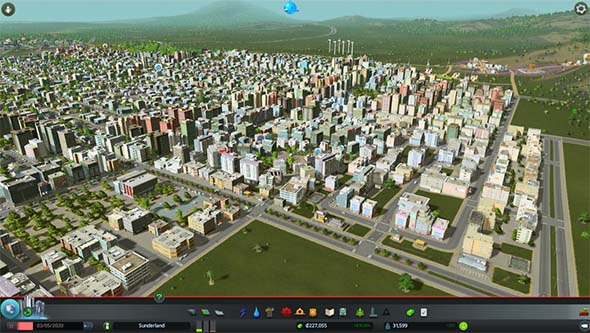
Cities Skylines - growing city
This game has very vibrant and attractive graphics and art styles that make the city look alive.

The game also has a very simple interface that looks good and is easy to read. Navigating through the menus is comfortable and intuitive, and it doesn't take up very much screen space.

Much like Cities XL, Skylines also gradually unlocks new buildings, infrastructure, and services as the city grows. Again, as somebody who routinely ran my SimCity 2000 cities into bankruptcy by overbuilding services and utility infrastructures early, I appreciate how this feature creates a gentler learning curve and helps to tutorialize new players in how the new features work.

Skylines differentiates itself from Cities XL and SimCity by providing a much more comfortable compromise of pacing and scale...

[More]
Grid Clock Widget
12      60
11      55
10      50
09      45
08      40
07      35
06      30
05      25
04      20
03      15
02      10
01      05
Grid Clock provided by trowaSoft.

A gamer's thoughts

Welcome to Mega Bears Fan's blog, and thanks for visiting! This blog is mostly dedicated to game reviews, strategies, and analysis of my favorite games. I also talk about my other interests, like football, science and technology, movies, and so on. Feel free to read more about the blog.

Check out my YouTube content at YouTube.com/MegaBearsFan.

Follow me on Twitter at: twitter.com/MegaBearsFan

Patreon

If you enjoy my content, please consider Supporting me on Patreon:
Patreon.com/MegaBearsFan

FTC guidelines require me to disclose that as an Amazon Associate, I earn from qualifying purchases made by clicking on Amazon product links on this site. All Amazon Associate links are for products relevant to the given blog post, and are usually posted because I recommend the product.

Without Gravity

And check out my colleague, David Pax's novel Without Gravity on his website!

Featured Post

Exploring strange new ludic genres of Star Trek (on Patreon)Exploring strange new ludic genres of Star Trek (on Patreon)09/08/2025 2 years ago, after playing both Star Trek: Resurgence and Star Trek: Infinite, I started thinking about how the ludic genres of "point-and-click"-style adventure games and grand strategy games are both very good ludic genres for the Star Trek IP. I had originally planned on creating a short, 20-30 minute video talking about...

Random Post

Gags come fast, but don't land nearly as reliably in Deadpool 2Gags come fast, but don't land nearly as reliably in Deadpool 205/23/2018 Another summer, another onslaught of comic book movies. This year, we're spared the misery of another of Warner's DC Comic movies, so we get two Marvel movies (including the recently-released Infinity War and the soon-to-be-released Ant Man and the Wasp), and we get a sequel to Fox's Deadpool. The first Deadpool was pretty great,...

Month List

Recent Comments

Comment RSS