Hunter's Moon - title

I saw the PS5 exclusive Hunter's Moon advertised as a "folk horror" game about a witch hunt. I had no idea what "folk horror" was supposed to mean, but I was eager to try it out. Unfortunately, "folk horror" apparently isn't anything close to what I thought it was. I was thinking that of "folk horror" being something along the lines of a bigfoot story, or the Jersey Devil, or the Loch Nes Monster, or something along those lines. A local legend about a supernatural monster or creature that maybe hunts people who get lost in the woods.

Hunter's Moon is not anything like that. It is much more grounded and mundane. It's a medieval "witch hunt" in both the literal and figurative sense.

The player takes on the role of a young girl who is accused of being a witch by the local Christian fundamentalists, and who must run away to try to escape their pursuit. She runs through the woods, and through parts of her home village, stopping occasionally to try to seek refuge in a neighbor's home, or simply to eavesdrop on her neighbor's conversations.

Half the game is being chased through woods and village outskirts by witch-hunters.

This is basically the whole game. It's one part walking or running through forests (and occasionally being chased by witch hunters), and one part standing outside of a window, listening to the conversations of the people inside. If you are one of those "gamers" who can't tolerate a "walking simulator", then you better stay far away from this one.

Being a real gamer, however, who doesn't mind an interactive narrative here and there, I decided to power on even after I had realized that the game wasn't quite the "haunted forest" Halloween game that I thought and expected it to be. But even I got pretty bored with this one.

Eavesdropping simulator

The biggest problem for me was that the game simply requires far too much standing around doing nothing. On the one hand, I appreciate that the narrative is conveyed through something a bit more interesting and expressive than a bunch of notes and diaries scattered around. Unlike most walking sims, the player learns the game's story and "lore" by overhearing or eavesdropping on conversations by other characters who are almost always out of sight. They are either holed up in their houses while the witch hunt is going on, or they are somewhere off the beaten path of the forest, where you can't see or reach them. It's not quite the immersive gameplay vignettes of What Remains of Edith Finch, but it's a lot more natural and organic than finding a bunch of notes and diaries everywhere you go.

I also appreciate that this design means that the important events of the story are happening now. Most walking-sim games have the player piecing together (from written notes) the events of a story that has already happened. In Hunter's Moon though, you are actually playing the important part of the story.

[More]

Star Trek Deep Space Nine

In the age of streaming and binge-watching here in the year 2023, long-form serialized television is now ubiquitous. Every network and streaming service has wanted its own blockbuster TV shows. Whether it's AMC's The Walking Dead and Breaking Bad, HBO's Game of Thrones, Sci-Fi's Battlestar Galactica, Netflix's House of Cards and Stranger Things, History's Vikings, and so forth, it seems that every big new show outside of sit-coms has a heavily-serialized format. Procedural dramas are going the way of the dinosaur.

Serialized, long-form television may be commonplace now, but back in the 1990's, it was virtually unheard of outside of daytime soap operas (such as Dallas and Dynasty) and the occasional network mini-series. At least, this was the case in the United States. British television has a much longer track record of serialized story-telling. A big part of why serialized television was uncommon was that the producer(s) of network syndicacted shows didn't have as much control over when its affiliates decided to air the shows, or how heavily they would market and advertise it. Furthermore, the networks or affiliates could change the time slot of the show pretty much at a whim. Viewership, therefore, would be much more fickle and fractured. Audiences would pop in and drop out. Expecting the audience to have seen every previous episode in preparation for this week's episode was a dangerous and risky expectation for a production studio. It's easy to lose viewers if none of them know what's going on.
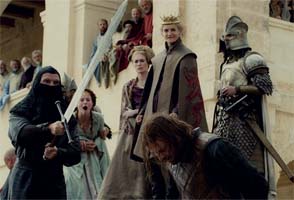
Game of Thrones - Ned Stark
- Game Of Thrones, copyright HBO
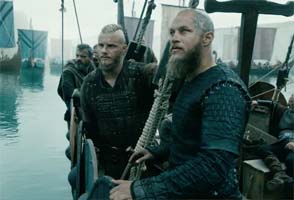
Vikings - Ragnar and Bjorn
- Vikings, copyright History Channel
Highly serialized, long-form drama are the norm for modern networks and subscription television services.

As I mentioned in the previous essay, this was the case with me. I was in elementary school and middle school during DS9's run, and I missed a lot of episodes in the first couple seasons, despite wanting to watch the show. Missing so many episodes meant that I had very little idea what was going on when I would watch, and so I mostly lost interest in the show. If my dad was watching it, and I was there, I'd watch it, but I wasn't planning my day around it.

Looking back now, that sort of serialized story-telling is now ubiquitous and expected, and so it's easier to recognize that Deep Space Nine was truly innovative and ahead of its time in this regard.

Long-form story-telling

Serialized story-telling wasn't alien to Star Trek. Deep Space Nine premiered in 1993, the same year as the sixth season of Next Generation. By this time, The Next Generation had several story threads that had recurred over the course of a season, or over multiple seasons -- as well as several attempted overarching plot threads that were dropped.

As early as the first season of Next Generation, Q had become a recurring antagonist, and his "judgement" over the human race was established as a recurring plot thread. Heck Q's judgement of humanity was originally depicted as the framing mechanism for the entire show! It was scaled back in the following seasons due to the general poor reception of the first season, and the fact that John de Lancie just works better in a more whimsical and comic role.
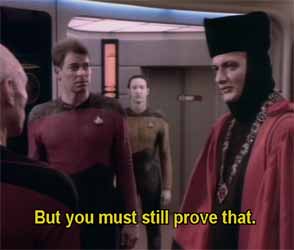
Star Trek TNG - Judge Q
- TNG "Encounter At Farpoint", season 1, episode 1
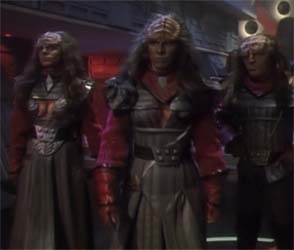
Star Trek TNG - Duras sisters
- TNG "Redemption, Part I", season 4, episode 26
TNG had several recurring plot threads.

The final two episodes of Next Generation's first season, "Conspiracy" and "The Neutral Zone", seem to have been part of an abandoned attempt at more long-form story-telling. Both seem to be trying to establish some new threat to the Federation (and possibly a shared threat between the Federation and other rival powers such as the Romulans). I think the original idea was for this to become an overarching storyline for the entire series. But the thread from "Conspiracy" was completely dropped, and the destroyed colonies referenced in "The Neutral Zone" were re-written to be retroactive foreshadowing of the Borg's appearance in season 2.

[More]
Grid Clock Widget
12      60
11      55
10      50
09      45
08      40
07      35
06      30
05      25
04      20
03      15
02      10
01      05
Grid Clock provided by trowaSoft.

A gamer's thoughts

Welcome to Mega Bears Fan's blog, and thanks for visiting! This blog is mostly dedicated to game reviews, strategies, and analysis of my favorite games. I also talk about my other interests, like football, science and technology, movies, and so on. Feel free to read more about the blog.

Check out my YouTube content at YouTube.com/MegaBearsFan.

Follow me on Twitter at: twitter.com/MegaBearsFan

Patreon

If you enjoy my content, please consider Supporting me on Patreon:
Patreon.com/MegaBearsFan

FTC guidelines require me to disclose that as an Amazon Associate, I earn from qualifying purchases made by clicking on Amazon product links on this site. All Amazon Associate links are for products relevant to the given blog post, and are usually posted because I recommend the product.

Without Gravity

And check out my colleague, David Pax's novel Without Gravity on his website!

Featured Post

Exploring strange new ludic genres of Star Trek (on Patreon)Exploring strange new ludic genres of Star Trek (on Patreon)09/08/2025 2 years ago, after playing both Star Trek: Resurgence and Star Trek: Infinite, I started thinking about how the ludic genres of "point-and-click"-style adventure games and grand strategy games are both very good ludic genres for the Star Trek IP. I had originally planned on creating a short, 20-30 minute video talking about...

Random Post

Madden 26 roster with practice squad players now availableMadden 26 roster with practice squad players now available09/17/2025 When you start a new Franchise in a Madden NFL game, you get 2 options: Use preseason rosters, Use current active roster. For simulation users looking to start a new Franchise in the preseason, neither of these options is ideal. The preseason roster gives you all of the preseason players, but it does not include ratings changes,...

Month List

Recent Comments

Comment RSS