
While I was searching the PlayStation Store for some VR games to play on my PSVR2 headset (and on a PS4 VR headset that a friend let me borrow, since the PSVR2 headset isn't backwards-compatible), I stumbled upon an old sci-fi game that had apparently slipped under my radar when it released back in 2016. That game is a near-future space disaster game called ADR1FT. Unfortunately, this particular game doesn't have PSVR support, even though it apparently does have PC VR support, but it looked pretty and intriguing, so I bought it anyway.
Space station by Michael Bay and Roland Emmerich
In ADR1FT, the player plays as an astronaut who is a survivor of a catastrophic disaster aboard an orbital space station. The entire station has broken apart, and even the sections that are still intact are without power or life support. It is up to the player to explore the debris, look for any other survivors, and restore enough power and computer functionality to escape back to Earth in an Emergency Escape Vehicle (EEV). Personally, I think it's silly that an Emergency Escape Vehicle would be rendered useless in the event of an emergency that disables power and computer functionality. Kind of defeats the purpose of such a vehicle. One would think that such a vehicle would have an independent power supply and computer, and some way of detaching or ejecting the vehicle without the station being powered -- like, I don't know, some kind of explosive decompression of the clamps that attach the escape vehicle to the station, which works based on simple physics, rather than requiring power or computers.
But whatever, suspension of disbelief. I have to restore power to the main computer to get the escape pods to work. Fine. I can live with that contrivance.
The space station debris hovering over the Earth is a striking visual.
The space catastrophe itself is loaded with striking visual details. From the vistas of the Earth spinning below, to the fields of debris suspended in space, to water bubbles floating around certain chambers, ADR1FT really sells the look and feel of being trapped on a near-future destroyed space station. This includes the feeling of isolation, loneliness, and hopelessness of being trapped in space. In fact, it might be too good at selling this aesthetic, because it does so to the point of occasional frustration. [More]
It's really nice to be seeing more pure science fiction games. Not sci-fi action games like Mass Effect or sci-fi horror games like Prey, in which the sci-fi is just incidental set dressing. But actual science fiction games that explore the human condition as it relates to our advancing technology and understanding of the universe. Games like Outer Wilds, Tacoma, Silicon Dreams, Event [0], and others have been a nice distraction from shooting endless hordes of zombies, demons, and robots.
This is especially true considering that most sci-fi movies and TV shows are more action-heavy and less cerebral. While a movie like Arrival or The Martian comes around every few years and totally blows me away, the days of movies like 2001: A Space Odyssey and Close Encounters of the Third Kind are long gone. Even my beloved Star Trek is trying too hard to look and feel like Star Wars, instead of embracing the low-budget stories and techno-babble that helped make The Next Generation so beloved.
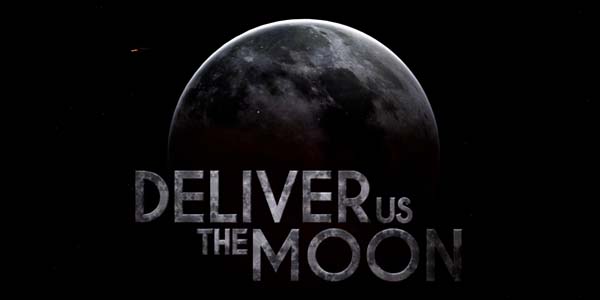
Well, the indie gaming sphere has been pumping out new sci-fi games pretty reliably over the past few years. But they can't all be gems like Outer Wilds. Most are pretty mediocre. Deliver Us The Moon has the potential to be a real gem, but it is held back by poor technical performance (on the PS5) and a final chapter that dragged on and had me more frustrated than contemplative.
The basic concept is that, in the coming decades, humans discover a new isotope of helium on the moon. This isotope is a potent energy source that is mined and processed on the moon, and beamed back to the Earth to supply almost all of humanity's energy needs. However, after years of successful operation (and after humans on Earth have become dependent on the cheap, abundant moon power), the moon colony suddenly shuts down with no word or warning as to why. After years of silence and darkness, our playable character is launched to the moon to figure out why the energy stopped flowing, and to hopefully turn it back on.
In space, no one can hear the game crash
Right off the bat, I was annoyed by the camera controls. Within 10 minutes or so of starting Deliver Us The Moon, I had to go into the settings to increase the camera's sensitivity on the X-axis. Even after doing this, rotating the camera still felt sluggish. I'm not sure how much of this is deliberate. An astronaut in a space suit should feel a bit clunky to move around. But movement and camera panning are different things, and I don't know if clunky movement for an astronaut should translate to sluggish movement by the camera. This wasn't helped by the fact that quickly panning the camera often caused the framerate to stutter (which may also have been a reason for the slow default camera speed).
Earth will be largely without electricity unless we can restore the moon colony.
I was surprised and disappointed by how poorly Deliver Us The Moon performs on the PS5, especially considering that it's a pretty small game that mostly takes place in the confines of a small moon base. It's not like it's rendering a massive open world, or computing enemy pathfinding, or combat A.I., or supporting dozens of players in multiplayer. Yet the framerate is constantly dropping while just walking around the station.
In one case, I walked around a desk to check if the computer had any open emails that I could read, the game just crashed completely. It autosaves frequently, so I only lost a minute or 2 of progress. But still, why does such a simple little game have such horrendous performance problems on a "next-gen" console? I don't know if the PC or XBox versions are this bad, but regardless of which platform you play on, be prepared for crashed, freezes, and framerate drops.
[More]
When I played it last year (after waiting over a year for its timed Epic Store exclusivity to end), Outer Wilds quickly became one of my favorite games ever due to its innovative sci-fi, exploratory gameplay in its dynamic sandbox solar system full of interesting places that are genuinely worth exploring. It was a compelling sci-fi game about the nature of science and the desire to find out place in the universe. It was also a compelling player-driven mystery game that doesn't hold the player's hand and which provides genuine "eureka!" moments.
I wasn't expecting an expansion because the game seemed so perfect and self-contained that I struggled to even think of what could be included in an expansion. Would they add more planets to the solar system? Would it be a stand-alone prequel with the player playing as one of the extinct Nomai?
But I sure as hell was not going to pass up an excuse to revisit Timber Hearth!
I wasn't going to pass up an excuse to revisit Timber Hearth!
River rafting around the world
One of my favorite things about Outer Wilds is its open-ended exploration of the hand-crafted solar system. Each world is a little puzzle box for the player to unlock, with the solutions to every puzzle involving some sci-fi physics concept that the player has to learn and apply.
The puzzles of Echoes of the Eye don't seem to have that same sci-fi quality to them. Most puzzles involve the use of light, and feel like they could be puzzles in any earthbound adventure or fantasy setting. I just point flashlights at things to trigger mechanisms, turn lights off or on to trigger secret passageways, or turn off my source of light to sneak past photo-sensitive sentries in the dark. I guess I should praise the puzzle design for never falling back on the tried-and-true (yet rote) method of reflecting light off mirrors or through prisms. The actual puzzles are a bit more clever than this, but I just don't find it to be a very engaging or interesting gimmick, especially compared to how novel and creative the core Outer Wilds puzzle box is.
The use of light as the instrument for most interactions with Echoes of the Eye seems to be the result of a concerted effort by the developers to use base game mechanics that are under-utilized in the base game, such as the flashlight and ability to nap at bonfires. The puzzles just lack that sense of awe and discovery that comes with progressing in the base game.
Echoes of the Eye starts off strong with solving a space-based mystery.
Some of the late puzzles do start to embrace Outer Wilds's sci-fi nature. They hide some very fun and interesting surprises that really mess with the player's perception of reality in a very video-game-meta sort of way. But they are so esoteric that the game almost has to literally tell the player what to do. It's like "summoning the tornado in Simon's Quest" levels of esoteric at times.
Honestly, I think the single best puzzle in the game is the one that the player has to solve just to get access to the DLC! It's also the most "Outer Wilds" feeling puzzle in the game. The developers managed to cleverly hide the DLC in plain sight, as if it had been there all along.
The opening for the DLC tasks the player with finding a remote satellite and solving a simple puzzle involving it. Then the expansion treats the player with the awe-inspiring discovery of a massive hidden world that makes up the expansion's primary setting. After that, however, everything feels like pretty typical adventure game stuff. Instead of planet-hopping in a tiny space capsule, I find myself white-water rafting and watching home movies on slide projectors. Later on, there's some horror-adjacent exploration of dark spaces with just a flashlight, and even a little bit of hide-and-seek. Again, it's nothing I haven't seen in a hundred other indie games.
[More]
15313440-eb6a-44bf-a4ea-2d4d369d1f4e|0|.0
Tags:Outer Wilds, Echoes of the Eye, Steam, PC, Epic Game Store, science fiction, mystery, exploration, open world, Eye of the Universe, solar system, space, ring world
I refuse to give money to Epic,
and waited for Steam release.
Outer Wilds was one of my most anticipated games in 2019. As such, it was immensely disappointing that it became a timed exclusive for the Epic Games Store. I have a lot of issues with how Epic Games runs its business, and with the ethics (or lack thereof) of the company, and so I refuse to give them a single penny of my money. Our daughter plays Fortnite with her friends, and we're not going to disallow her from doing such (and besides, her socialization options were incredibly limited during the COVID-19 pandemic lockdown, and I think playing Fortnite stopped her from going stir crazy). But I've told her that the first time she asks me for money to buy V-Bucks, it will be the last time she plays the game.
I could have bought Outer Wilds on PS4 a year ago, but it just looked like the kind of game that would be better experienced on PC. I've been burned enough times by Bethesda RPGs that I'm always skeptical of a console's ability to adequately run a game with a world of the scope and comlexity of Outer Wilds. So I bit the bullet and waited the year for the game to release on Steam.
The opening screen recommended the use of a game pad, and I obligingly started using my PS4 controller on my second play session. And I've read that the game ran just fine on consoles. So I guess I could have spared myself the wait and just played on PS4 from the start. Ah well, live and learn.
Outer Wilds plays best with a controller anyway, so there was no need for me to pass up the console release.
Now to go back to finishing Fallout: New Vegas while I await the Steam release of The Outer Worlds...
Knowledge is your upgrade
Readers of my blog know that I'm not a huge fan of most open world games. The sandboxy nature of those games tends to lead to stagnant stories and worlds that feel ironically dead. They also tend to be full to the brim of monotonous copy-pasted content that becomes a drag to play.
Outer Wilds offers an entire solar system as an open world sandbox for you to explore. Granted, the scale of this solar system is considerably shrunk down in order to accommodate a game, such that an entire planet is about as big as a small neighborhood, and the different planets are only a few kilometers apart from one another. It's fine. It works well enough with the game's cartoony aesthetic style.
You have an entire toy solar system to play in.
What's important though, is how rich with detail and intrigue this world solar system is. Nothing looks or feels copy-pasted. Every nook and cranny of the map contains something new that you haven't seen before. On top of that, the map is positively dynamic! [More]
22d4dd2b-5bc2-4d04-90ed-eb6257d5218e|1|5.0
Tags:Outer Wilds, Steam, PC, Epic Games Store, timed exclusive, space, solar system, exploration, open world, nova, Nomai, comet, black hole, time loop, science fiction, mystery, No Man's Sky, Star Trek
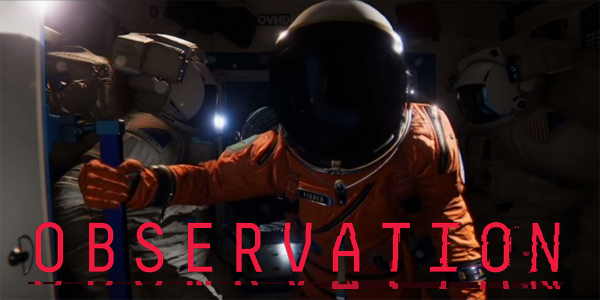
It's real refreshing to come across a science fiction game that isn't just about shooting aliens with laser guns or blowing up space ships. If you're in the market for a thoughtful, well-presented science fiction experience, then I highly recommend that you check out Observation. If you're also into horror, then even better, because this game definitely has some horror elements as well. They're much more subdued, but this game does do a fantastic job of creating a building sense of tension and intrigue as its over-arching mystery is slowly unfurled.
The gimmick here is that you play as a malfunctioning artificial intelligence on a near-future orbital research station. The game is presented as a sort-of found-footage narrative (think along the lines of the Apollo 18 horror movie) told entirely from the point of view of the on-board A.I. Something goes wrong, the crew are all missing and possibly dead, and you help the sole survivor try to find the remaining crew and piece together what happened to the station. Think along the lines of playing as the HAL 9000 from 2001: A Space Odyssey, or as Kevin Spacey's character in the [fantastic] movie Moon. You do this by jumping between different surveillance cameras (a la Five Nights at Freddy's, but, you know, with ambitions of being more than just a random jump-scare-generator). Through the cameras, you interact with various technology and station systems within your line of sight. You'll occasionally be asked questions or given commands by the surviving astronaut, and you chose how to respond.
You are an unreliable A.I.?
From the start, there's a certain degree of unreliable narrator going on. One of the very first actions that the game asks you to do is verify the identify of the surviving astronaut via her voice print. You are initially told that her voice print does not match, and you're given the option to accept or reject her voice print. If you reject, she'll repeat her authorization code, and you'll be told that it matches this time. Is she not who she seems? Are your own systems providing you with misleading information? Are your systems merely damaged? This creates an immediate sense of distrust. You (the player) don't necessarily trust the survivor, the survivor doesn't necessarily trust you, and you can't even trust your own perception and judgement.
From the start, it's unclear whether you can trust Emma, or whether she can trust you...
This immediately creates a dense atmosphere of intrigue and mystery and sets a level of tension that persists through the entire game.
This atmosphere is helped by the richly-detailed near-future space station that you inhabit. The visuals are immaculately detailed, and the station looks and feels like it could be modeled after the real-life International Space Station. The spaces are tight and claustrophobic. Accessories and stationary are strapped or velcroed to the walls, floors, ceiling, and desk surfaces in order to prevent them from floating off in the zero-gravity environment. Everything is believable.
The game further builds its atmosphere with its immersive U.I.. Every button press, command, and interaction has some in-universe context behind it that helps to keep you in the mind-space of your A.I. character. The U.I. is mostly easy to use, and most actions feel intuitive.
This game hooked me in with its setting and atmosphere, and I just had to keep playing to find out what happened and where this would go!
The space station and U.I. are believable and immersive.
... [More]
409df8bf-36a0-4560-ac9f-e173dd9fc208|0|.0
Tags:Observation, No Code, Devolver Digital, PSN, Epic Games Store, science fiction, horror, mystery, point-and-click, walking simulator, puzzle, indie gaming, camera, found-footage, unreliable narrator, space, astronaut, artificial intelligence, HAL 9000, 2001: a Space Odyssey, Five Nights at Freddy's, Saturn
|

| 12 | | | | | | | 60 | | 11 | | | | | | | 55 | | 10 | | | | | | | 50 | | 09 | | | | | | | 45 | | 08 | | | | | | | 40 | | 07 | | | | | | | 35 | | 06 | | | | | | | 30 | | 05 | | | | | | | 25 | | 04 | | | | | | | 20 | | 03 | | | | | | | 15 | | 02 | | | | | | | 10 | | 01 | | | | | | | 05 |
|